
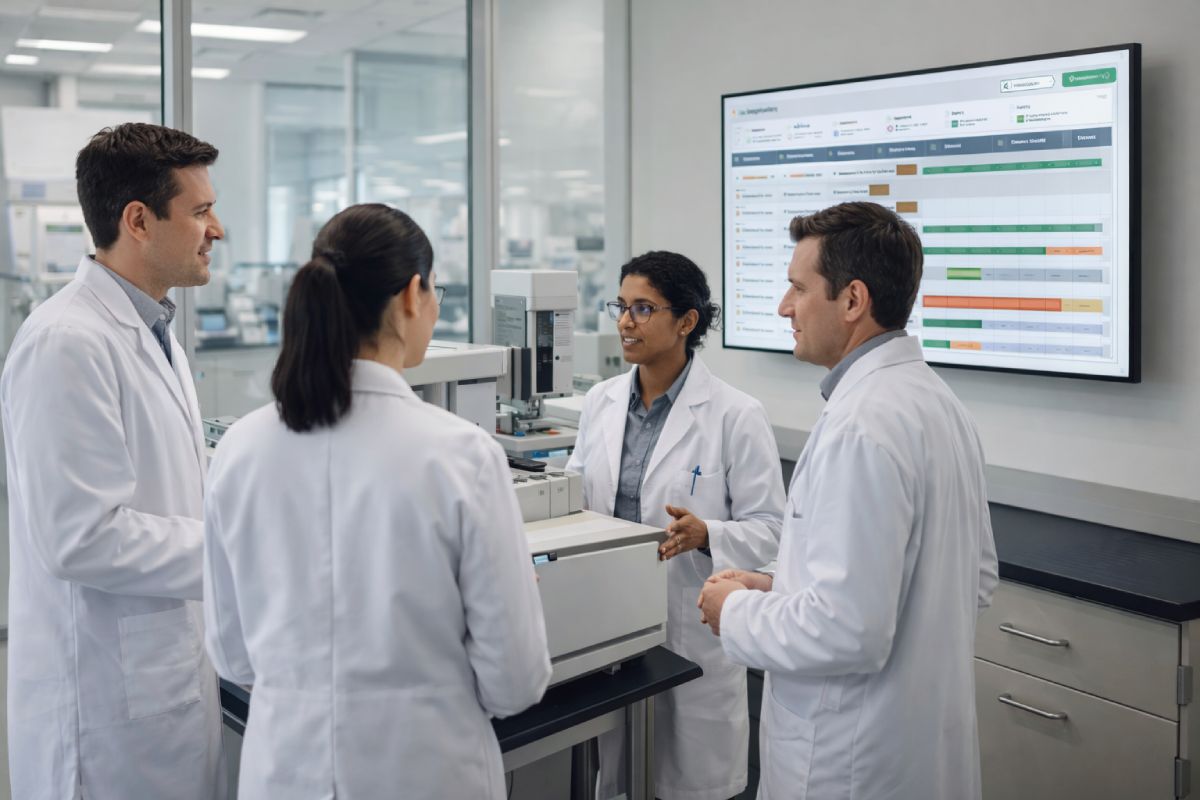
In large R&D organizations, shared laboratory equipment is both a critical enabler and a frequent bottleneck. High-value instruments such as imaging systems, analytical platforms, robotics, and specialized testing equipment are essential for research progress. Yet in many labs, access to these resources is still managed through spreadsheets, Outlook calendars, emails, or informal sign-up sheets.
As R&D environments scale across multiple labs and locations, manual scheduling methods begin to break down. Scientists struggle to find available time slots. Equipment sits idle while teams assume it is unavailable. Lab Operations Managers spend hours coordinating bookings, resolving conflicts, and answering basic availability questions. IT teams inherit fragmented systems that do not scale or integrate cleanly with enterprise platforms.
This is where lab equipment scheduling software becomes foundational. More than a digital calendar, modern scheduling software brings structure, visibility, and automation to how shared equipment is managed. When implemented correctly, it reduces downtime, eliminates administrative friction, and enables coordinated research across complex, multi-site R&D organizations.
This article explores why scheduling fails at scale, how modern lab scheduling software changes the equation, and how newLab® helps R&D teams streamline equipment access with enterprise-ready automation.
Why Lab Equipment Scheduling Breaks Down at Scale
Scheduling challenges rarely appear in small labs. They emerge when organizations grow, diversify research programs, and distribute work across multiple sites.
In enterprise R&D environments, equipment scheduling breaks down for several interconnected reasons.
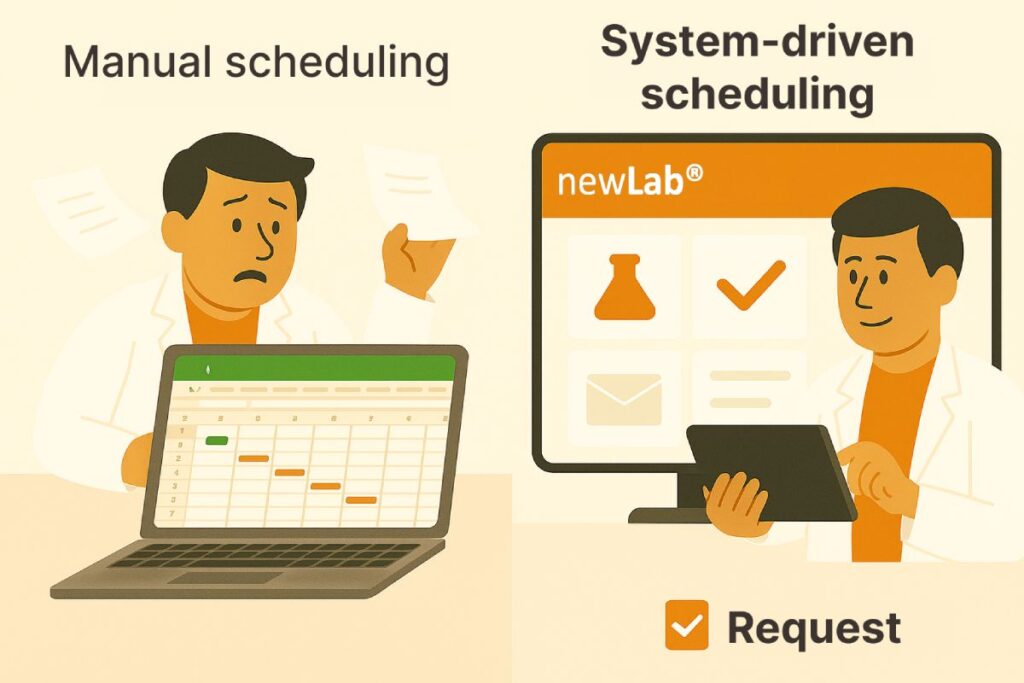
Manual tools cannot keep up with complexity.
Email threads, spreadsheets, and shared calendars were never designed to manage hundreds or thousands of shared assets across locations. As usage increases, these tools become inaccurate almost immediately and create conflicting sources of truth.
There is no real-time visibility.
Scientists often cannot see:
- Who is currently using the equipment
- When will it be available next
- Whether it is operational or temporarily unavailable
As a result, lab managers must manually verify availability, creating delays and frustration for research teams.
Scheduling conflicts become common.
Without automated controls, double bookings occur frequently, last-minute cancellations disrupt experiments, and priority disputes slow collaboration and damage trust between teams.
Multi-site coordination becomes nearly impossible.
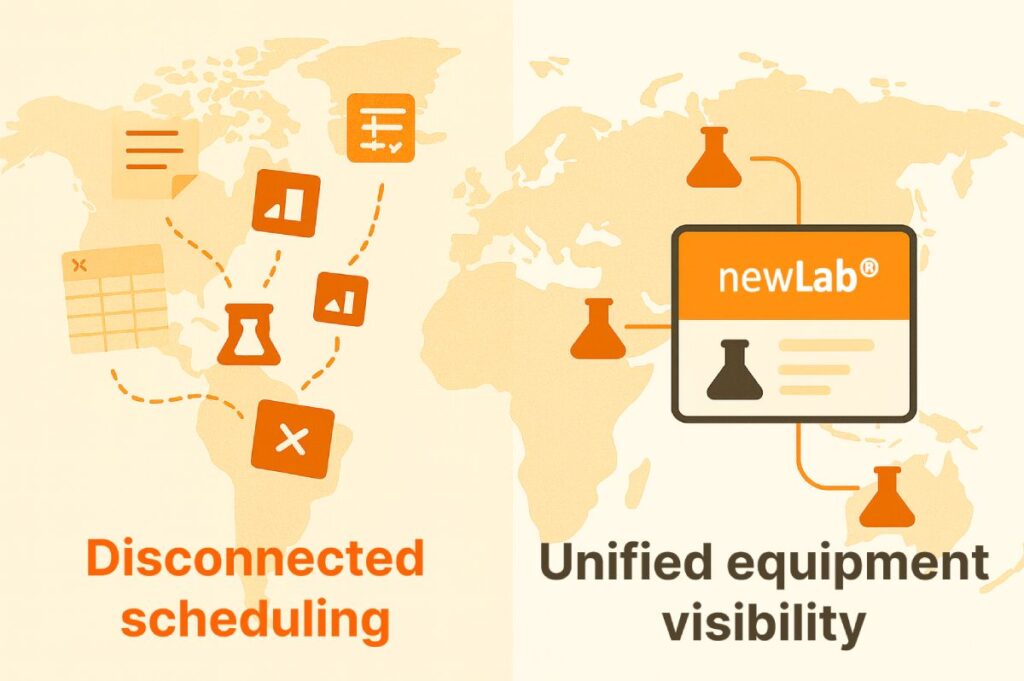
When labs operate across buildings, campuses, or countries, local scheduling tools fail to provide a global view of shared resources. Teams cannot easily balance demand or redirect work across locations.
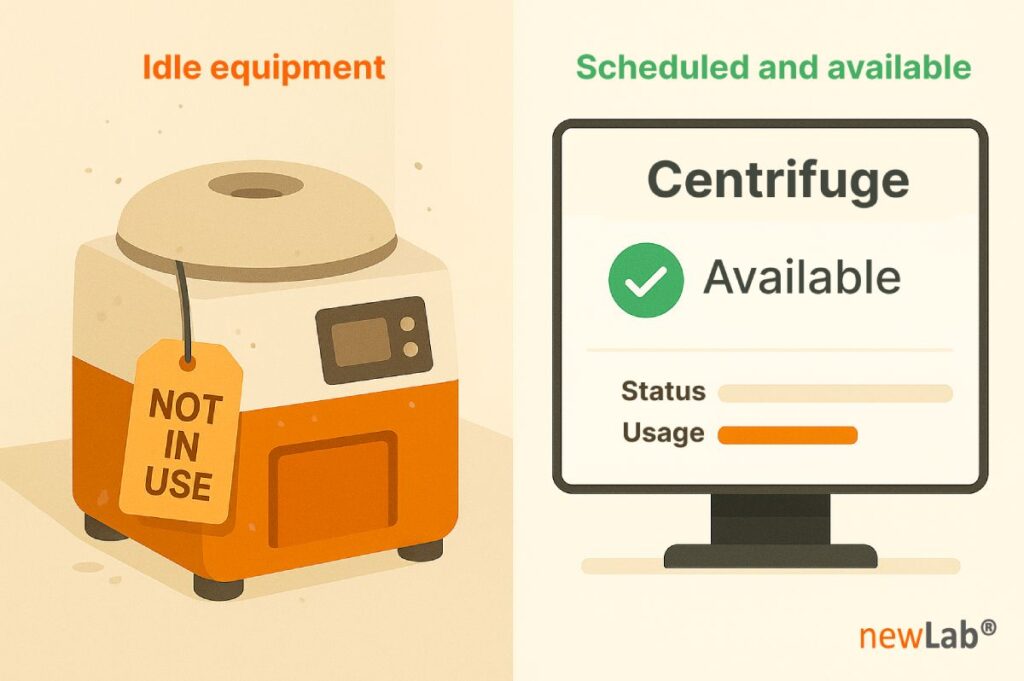
High-value assets remain underutilized.
Without utilization insights:
- Organizations overestimate demand in some areas
- Available capacity is underestimated in others
- Expensive equipment sits idle while teams wait elsewhere
These challenges compound quickly. What starts as a scheduling inconvenience becomes a productivity problem that affects experiment timelines, collaboration, and overall R&D efficiency.
What Modern Lab Equipment Scheduling Software Enables
Modern lab scheduling software is designed to operate as part of lab infrastructure, not as a standalone calendar. It connects scheduling with asset data, workflows, and enterprise systems to create a coordinated operating model.
From Manual Booking to Automated Coordination
Automation replaces the need for manual oversight. Instead of emailing lab managers or checking outdated spreadsheets, scientists can book equipment through a centralized digital interface.
Scheduling rules are enforced automatically. Availability updates in real time. Conflicts are prevented before they happen. Cancellations and changes are reflected instantly, reducing uncertainty across teams.
This shift removes human dependency from scheduling and ensures consistency across labs and locations.
Real-Time Visibility Across Shared Resources
Modern lab equipment booking software provides a live view of equipment availability, usage history, and upcoming reservations. Scientists can see which instruments are free, which are booked, and when capacity opens up.
Equipment availability is directly influenced by maintenance and calibration of the equipment. When maintenance activities are overdue or a calibration date has been missed, the equipment should no longer appear as available for booking. By linking scheduling to asset status, labs prevent unusable equipment from being reserved and avoid last-minute disruptions to experiments.
Lab Operations Managers gain visibility across all labs, not just their local environment. This enables better coordination, improved planning, and faster resolution of bottlenecks.
Visibility also supports smarter decisions about where to run experiments and how to balance workloads across sites.
Scheduling as an Operational System, Not a Calendar
True laboratory scheduling software treats scheduling as an operational capability tied to assets, services, and workflows.
Scheduling connects to equipment lifecycle data, maintenance activities, and usage analytics. It becomes part of a broader system that supports operational planning, resource optimization, and long-term scalability.
In enterprise R&D environments, scheduling does not operate in isolation. Availability is directly connected to asset status, usage history, and lifecycle data. When scheduling is integrated with the asset management system, teams gain a more accurate and reliable view of which equipment can actually be booked at any given time.
This is especially important in environments with shared equipment booking software used by multiple teams, departments, or research programs.
The Productivity Impact of Automated Scheduling
The impact of automated scheduling extends far beyond convenience. It directly influences how quickly and efficiently research teams operate.
Reduced downtime is one of the most immediate benefits. When equipment availability is clear and scheduling conflicts are minimized, idle time drops significantly. Instruments are used more consistently throughout the day and across sites.
Experiment setup becomes faster. Scientists spend less time coordinating access and more time preparing experiments. Delays caused by uncertainty or last-minute changes are reduced.
Planning improves for peak demand periods. With historical and real-time scheduling data, lab teams can anticipate bottlenecks and adjust resource allocation proactively.
Administrative workload decreases. Lab managers no longer need to mediate bookings, track usage manually, or reconcile conflicting calendars.
Over time, these improvements compound. Even modest gains in scheduling efficiency can translate into weeks of saved research time across large R&D organizations.
How Scheduling Improves Collaboration Across R&D Teams
Effective scheduling is not just a technical improvement. It reshapes collaboration across the organization.
Benefits for Scientists
Scientists benefit from predictability and autonomy. With modern lab booking software, they can book equipment independently, plan experiments with confidence, and avoid unnecessary delays.
Clear scheduling reduces interruptions and improves experiment continuity. Scientists spend less time coordinating logistics and more time focused on research.
Benefits for Lab Operations Managers
Lab Operations Managers gain control and oversight. Centralized scheduling provides a real-time view of demand, utilization, and capacity constraints.
This visibility allows managers to balance workloads, identify underused assets, and support multiple teams more effectively. Scheduling becomes a strategic lever rather than a daily firefighting task.
Benefits for IT Teams
For IT teams, scheduling software must scale, integrate, and align with enterprise systems. Standalone tools often create new silos and support challenges.
Enterprise-grade scheduling embedded within existing platforms simplifies governance, reduces technical debt, and ensures long-term scalability across sites and regions.
How newLab® Powers Enterprise Lab Equipment Scheduling
newLab® is the ultimate digital platform for managing lab resources and services, built natively on the ServiceNow platform. It enables enterprise R&D organizations to move beyond manual calendars and adopt a unified approach to lab equipment scheduling software.
newLab® centralizes scheduling across labs and locations, giving scientists and managers a shared, real-time view of equipment availability. Scheduling is directly connected to asset data, workflows, and operational context.
Scientists interact with a simple, intuitive booking experience designed for daily use. They can reserve shared equipment, view upcoming bookings, and plan work without relying on emails or spreadsheets.
Lab Operations Managers gain cross-site visibility and coordination capabilities. They can monitor demand, adjust scheduling rules, and support multiple teams with consistent processes.
Because newLab® is built on ServiceNow, scheduling aligns naturally with enterprise workflows and IT standards. This ensures scalability, reliability, and integration without introducing another disconnected system.
The Measurable Impact of Lab Equipment Scheduling Software
Automated scheduling delivers measurable operational improvements when compared to manual or legacy approaches.
| Scheduling Area | Manual or Legacy Scheduling | Automated Scheduling with newLab® |
| Booking Method | Emails, spreadsheets, shared calendars ❌ | Centralized digital booking system ✅ |
| Equipment Visibility | Limited and site-specific ❌ | Real-time, cross-site visibility ✅ |
| Downtime | Frequent idle periods ❌ | Reduced idle time through optimization ✅ |
| Scheduling Conflicts | Common and disruptive ❌ | Automatically prevented ✅ |
| Scalability | Breaks down as labs grow ❌ | Designed for enterprise R&D scale ✅ |
| Scientist Experience | High administrative burden ❌ | Simple, self-service booking ✅ |
These gains support faster experiment execution, better asset utilization, and more predictable research operations across complex environments.
Scheduling as a Strategic Lever for R&D Performance
As R&D organizations invest in advanced technologies and expand research programs, scheduling becomes a strategic capability rather than an operational afterthought.
Effective scheduling enables faster research cycles by reducing delays and uncertainty. It improves capital utilization by ensuring expensive equipment is used efficiently. It enhances planning accuracy by providing data-driven insights into demand and capacity.
Most importantly, scalable scheduling supports growth. As labs add new sites, teams, and technologies, a centralized scheduling platform ensures consistency and coordination across the enterprise.
In this context, lab equipment scheduling software is not just a productivity tool. It is a foundation for sustainable, high-performing R&D operations.
Ready to Streamline Lab Equipment Scheduling?
Manual calendars and ad hoc scheduling methods cannot support the complexity of modern R&D environments. Automated scheduling replaces uncertainty with clarity, reduces downtime, and improves coordination across teams and locations.
By adopting enterprise-grade lab equipment scheduling software, R&D organizations enable scientists to focus on research, Lab Operations Managers to operate with control, and IT teams to support scalable infrastructure. See how newLab® helps R&D teams streamline lab equipment scheduling and unlock higher productivity.
FAQs:
1. What is lab equipment scheduling software?
Lab equipment scheduling software is a digital system that manages how shared laboratory instruments are booked, tracked, and accessed across teams. It replaces manual calendars with real-time visibility and automated coordination.
2. Why do manual calendars fail for lab equipment scheduling?
Manual calendars cannot scale with shared equipment, multiple users, or multi-site R&D environments. They lack real-time updates, conflict prevention, and visibility into actual equipment availability.
3. How does lab equipment scheduling software reduce downtime?
Automated scheduling improves utilization by preventing conflicts, revealing idle capacity, and aligning bookings with real availability. This ensures equipment is used more consistently and predictably across labs.
4. What is the difference between lab booking software and shared equipment booking software?
Lab booking software typically focuses on individual labs or teams, while shared equipment booking software supports cross-team and cross-site access to high-value instruments. Enterprise R&D environments usually require shared scheduling capabilities.
5. How does lab equipment scheduling software support multi-site R&D teams?
It provides centralized visibility across locations so teams can coordinate equipment usage beyond a single lab. This enables better planning, load balancing, and collaboration across distributed research environments.