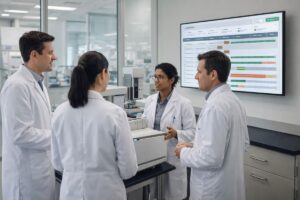

Most R&D labs operate the same way. Equipment data lives across spreadsheets, maintenance logs sit buried in email threads, and nobody has a clear picture of what is available, what needs servicing, or what is actually being used until someone urgently needs to know. That scramble to pull information together is not just frustrating. It is a symptom of a structural problem: the lab’s operational data is reactive by design.
The shift happening across pharmaceutical, biotech, and research-driven organizations points in a different direction. Labs that run on continuous, structured data outperform labs that depend on periodic snapshots and manual updates. Lab tracking software is the engine behind that shift.
This guide breaks down what continuous lab visibility looks like in practice, why it matters for R&D operations, and how to build it into your lab’s infrastructure using the right lab equipment tracking software.
The Problem With Reactive Lab Management
Every lab manager has lived through a version of this: a scientist books an instrument that another team already reserved. A piece of equipment that needed calibration last month is still running. A procurement request gets submitted for an asset that is sitting unused in another building, because no one had a way to check.
These are not isolated incidents. They are the direct result of lab equipment data that is fragmented, manually maintained, and almost always out of date. When your tracking system relies on spreadsheets, personal calendars, and paper logs, the data you work with reflects the past, not the present.
The compounding cost of this model is significant across every dimension of lab operations. Equipment sits idle in one lab while teams elsewhere wait weeks for access. Maintenance gets skipped because no one flagged the upcoming service window. Budget decisions get made on incomplete utilization data, leading to unnecessary capital expenditure on instruments that already exist in the organization.
For IT Directors and Lab Operations Managers in pharma and biotech, these inefficiencies are not abstract. They translate directly into slower experiments, inflated operating costs, and scientists spending hours on coordination that should take minutes.
When Equipment Data Lives in Spreadsheets
Spreadsheets are not inherently the problem. The problem is that they require someone to update them. The moment that update is delayed, your equipment data is already inaccurate. Multiply that across dozens of instruments, multiple lab locations, and a rotating roster of scientists and technicians, and the picture becomes clear: manual tracking creates structural blind spots that no amount of effort can consistently close.
What Always-On Lab Visibility Actually Means
There is a useful way to think about the goal of modern lab tracking software. Rather than treating equipment data as something you gather when you need it, the goal is to build a lab environment where that data is simply always there.
“The data is always there, not prepared for an event.”
That distinction matters more than it might seem at first. Continuous lab visibility means your equipment records, booking data, maintenance history, and utilization metrics are current at all times. Not because someone opened a spreadsheet this morning and updated it. Because the system keeps itself current through automated data flows that require no manual intervention.
This is not a convenience upgrade. It is a fundamental change in how the lab operates. When data is always current, the questions that used to require investigation have immediate answers:
- What instruments are available right now?
- Which assets are approaching their next service window?
- Is the equipment in Lab 4 being used enough to justify its cost?
In a continuous data environment, those answers are already there. The lab is not preparing to have visibility. It already has it.
How Lab Tracking Software Builds a Continuous Data State
The move from reactive to continuous lab management does not happen in a single step. It is built layer by layer, starting with the right software infrastructure and expanding outward as the system matures.
Automated Equipment Monitoring
Instead of relying on scientists or lab managers to manually log equipment status after the fact, modern lab equipment tracking software captures usage and status data automatically through system workflows. When a booking is made, confirmed, or completed, the record updates without human input. When a maintenance window is approaching based on actual usage data, the system surfaces it before it becomes a problem. The equipment record reflects reality continuously, not whenever someone last opened a file.
Centralized Scheduling and Booking
One of the most immediate operational gains from implementing lab tracking software is centralized scheduling. Instead of bookings living in personal calendars and local logs, a shared system gives every team visibility into what is available, when, and under what conditions. Scheduling conflicts are eliminated at the source rather than discovered after they happen.
Underutilized instruments become visible across the organization. Scientists spend less time chasing availability and more time running the experiments they were hired to run.
Maintenance Tracking Without the Manual Work
Preventive maintenance is one of the highest-leverage activities in a lab and one of the most commonly delayed precisely because it depends on someone remembering to initiate it. When maintenance tracking is automated through lab equipment tracking software, service reminders go out on schedule based on real usage data, calibration records are logged as part of the equipment workflow, and the fit-for-use status of every asset is always current.
The lab does not need to chase this information. It is built into how the system operates.
Reactive vs. Continuous Lab Management: A Side-by-Side Comparison
The table below shows the practical difference between a lab that tracks equipment reactively and one that operates on a continuous data model through lab tracking software.
| Capability | Reactive Model | Continuous Model with Lab Tracking Software |
| Equipment availability | Checked manually or via email | Real-time booking system with live status |
| Maintenance scheduling | Triggered after an issue occurs | Automated preventative alerts on schedule |
| Utilization reporting | Compiled periodically (weekly/monthly) | Live dashboards, always current |
| Data entry | Manual, prone to errors and delays | Automated through system workflows |
| Equipment status | Often unknown until someone asks | Continuously tracked and visible |
| Cross-lab visibility | Limited, siloed per team or site | Centralized across all labs and locations |
| Procurement decisions | Based on outdated or incomplete data | Informed by real-time utilization analytics |
A Step-by-Step Guide to Implementing Lab Equipment Tracking Software
Getting from reactive to continuous lab visibility requires a structured approach. The technology is only part of the equation. How you implement it determines whether the shift is lasting and whether it delivers value across the full organization.
Step 1: Map Your Equipment Ecosystem
Before any software goes live, you need a complete and honest picture of what you are tracking. This means cataloguing every piece of equipment across every lab location, including its current status, maintenance history, assigned team, and actual utilization pattern.
For many organizations, this exercise surfaces inefficiencies that have been quietly accumulating for years: instruments barely used, assets duplicated across sites, maintenance records that have not been updated in months. That baseline inventory is the foundation on which everything else is built.
Step 2: Connect to Your Existing Enterprise Systems
Lab tracking software does not exist in isolation. The most effective implementations connect directly with the systems your organization already uses, whether that is ServiceNow for IT asset management, a LIMS for scientific workflows, an ERP like SAP or Oracle for procurement and finance, or a combination of all three. For IT Directors, this is a critical evaluation criterion. Adding a standalone tool that creates yet another data silo defeats the purpose entirely.
newLab® is built natively on ServiceNow, which means it integrates directly into the enterprise platforms most R&D IT teams already manage. There is no custom development required to establish that connection, and no new infrastructure to maintain separately from what already exists.
Step 3: Automate Workflows and Notifications
Once your equipment inventory is mapped and your systems are connected, the next step is building the automated workflows that eliminate manual touchpoints. This includes booking confirmations, maintenance reminders, calibration alerts, and utilization reports that run without anyone needing to initiate them.
Every manual input that gets replaced by an automated workflow is a reduction in both administrative overhead and the risk of data falling out of date.
Step 4: Build Real-Time Dashboards for Decision Makers
The final layer is visibility at the leadership level. Real-time dashboards give Lab Operations Managers and IT Directors a live view of equipment status, booking activity, maintenance schedules, and utilization rates across every lab location in the organization. These are not reports that someone compiles on Friday afternoon.
They are live views that reflect the actual state of the lab at any given moment, available to any stakeholder who needs them.
What to Look for in Lab Equipment Tracking Software
Not all lab equipment tracking software is built for the complexity of enterprise R&D environments. When evaluating options, prioritize the following capabilities:
- Native integration: Native integration with enterprise platforms
- Automated workflows: End-to-end automation that removes manual data entry from every stage of the equipment lifecycle
- Centralized scheduling: A shared booking system that gives every team real-time visibility into resource availability
- Live utilization analytics: Data that informs procurement, maintenance, and operational decisions in real time
- Enterprise scalability: The ability to grow from a single lab to a global R&D organization without requiring a full system rebuild
- Scientist-facing usability: A portal that gives lab teams direct access to resources and services without relying on IT for every interaction
The difference between a tool that tracks equipment and a platform that creates continuous lab visibility lies in how well these capabilities are integrated with the broader enterprise IT environment.
Why R&D Labs Choose newLab®
newLab® was built specifically for the complexity of enterprise R&D environments. As a platform natively integrated with ServiceNow, it gives IT Directors and Lab Operations Managers a single, always-current source of truth for every piece of equipment across every lab location, without adding new infrastructure or requiring custom development work to connect it to existing systems.
Scientists get a centralized portal to book resources, request services, and access equipment information without navigating multiple disconnected systems. Lab managers get real-time visibility into utilization rates, maintenance status, and scheduling across the entire organization. IT teams get a lab management layer that operates within the enterprise architecture they already maintain, rather than alongside it as yet another isolated platform.
The result is a lab that operates in a continuous data state by design. Equipment information is always current. Maintenance records reflect real usage. Booking conflicts are caught before they occur. And when any stakeholder needs to understand the current state of the lab, the answer is already there, not something that needs to be assembled from scratch.
The Shift Is About Architecture, Not Effort
The gap between reactive and continuous lab management cannot be closed by working harder or adding more people to maintain manual systems. It is closed by changing the fundamental architecture of how lab data is captured, maintained, and shared across the organization.
Lab tracking software is the foundation of that change. When implemented correctly and integrated with the enterprise platforms your organization already relies on, it transforms how R&D labs operate. Real-time visibility becomes the default. Manual data entry becomes the exception rather than the rule. And the operational decisions that used to require days of data gathering can be made in minutes.
If your lab is still relying on spreadsheets and disconnected manual processes to track equipment, the question is not whether to make the shift. It is how soon you can start.
Book a demo with newLab® to see what continuous lab visibility looks like in practice.