

As R&D organizations grow, lab workflows become increasingly complex. What once worked through email, spreadsheets, and informal coordination quickly turns into a bottleneck when labs scale across teams, sites, and research programs. Scientists spend more time navigating processes than focusing on experiments. Lab Operations teams struggle to maintain consistency. IT teams inherit fragmented systems that are difficult to scale or govern.
This is why software to automate lab workflows has become foundational for modern R&D environments. Rather than managing isolated tasks, leading labs are adopting platforms that centralize workflows, connect stakeholders, and support coordinated operations across the enterprise.
In this article, we compare the top 5 software platforms to automate lab workflows, based on real-world relevance, functional scope, and ability to support collaboration between scientists, Lab Operations, and IT teams. The goal is not to promote tools, but to help R&D leaders understand which platforms best support scalable, connected lab operations.
What Does Software to Automate Lab Workflows Actually Do?
At its core, software to automate lab workflows replaces manual, disconnected processes with structured, digital workflows that can be shared, tracked, and scaled.
From Manual Processes to Connected Workflows
In many labs, workflows still rely on email-based requests and spreadsheet tracking. Local tools are managed by individual teams with informal handoffs between functions.
Workflow automation centralizes these processes. Requests, approvals, scheduling, and execution move into a shared system where status is visible, and actions are coordinated.
This reduces delays, eliminates duplicated effort, and improves predictability for everyone involved.
Why Workflow Automation Matters at Enterprise Scale
As labs grow, complexity increases in three dimensions: number of users, number of workflows, and number of systems involved. Without automation, coordination becomes fragile and slow.
Laboratory workflow automation software provides a structure that allows labs to:
- Standardize how work is requested and delivered
- Scale processes across multiple sites
- Support collaboration between scientific, operational, and IT teams
- Maintain visibility without adding administrative overhead
This is where modern platforms differentiate themselves from task-specific or legacy tools.
How to Evaluate Lab Workflow Automation Software
Not all lab workflow software serves the same purpose. When evaluating options, R&D leaders typically consider:
- Breadth of workflow orchestration beyond a single use case
- Ability to support scientists, Lab Operations, and IT in one system
- Integration with existing enterprise platforms
- Scalability across labs, sites, and research programs
- Usability for day-to-day lab operations
These criteria help distinguish point solutions from platforms designed for enterprise R&D environments.
Top 5 Software to Automate Lab Workflows
1. newLab®
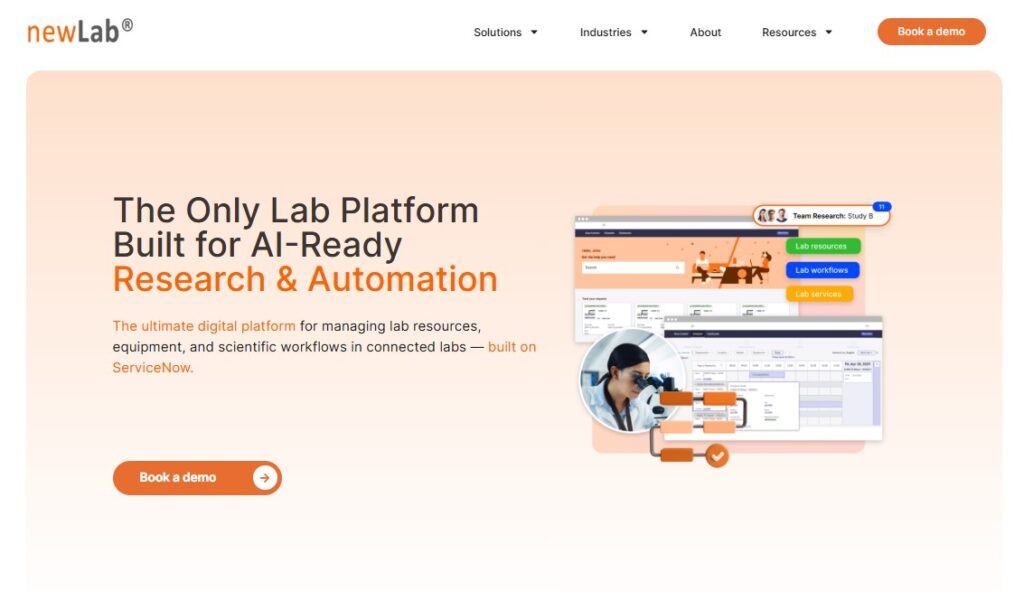
newLab® stands out as a smart lab software platform designed specifically to manage lab resources, services, and workflows at enterprise scale. Rather than focusing on a single function, newLab® centralizes operational workflows that connect scientists, Lab Operations, and IT teams in one shared environment.
newLab® enables labs to automate workflows such as service requests, equipment scheduling, and operational coordination, while maintaining visibility across sites and teams. Its native architecture on ServiceNow allows organizations to extend existing enterprise workflows into the lab without introducing disconnected systems.
What differentiates newLab® is not just automation, but context. Workflows are tied to lab resources, asset data, and operational status, enabling more accurate planning and coordination. Scientists benefit from simplified access to services and resources, Lab Operations teams gain real-time oversight, and IT teams support scalable infrastructure without additional complexity.newLab® is best suited for enterprise R&D organizations seeking a unified platform to manage lab workflows as part of broader digital operations.
2. Benchling
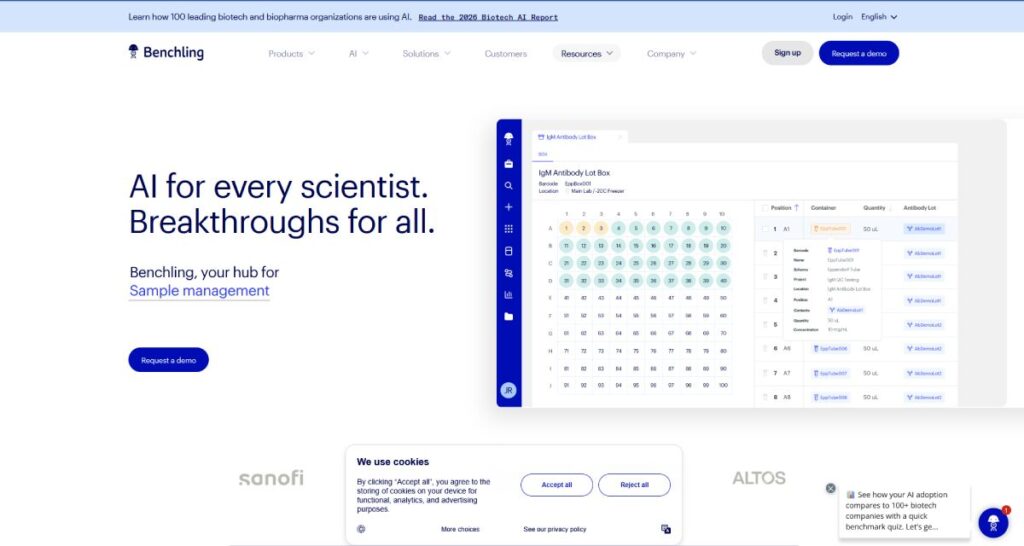
Benchling is widely adopted in life sciences research for its strong focus on scientific data management and collaboration. Its workflow capabilities are closely tied to experimental processes, making it particularly valuable for research teams working heavily with molecular biology and assay-driven workflows.
Benchling supports automation around experiment tracking, data capture, and collaboration between scientists. For research-centric workflows, it provides a strong digital foundation.
However, its workflow automation is primarily centered on scientific processes rather than broader lab operations. Organizations looking to automate operational workflows across Lab Operations and IT may find their scope more limited outside the scientific domain.
Benchling is best suited for research teams focused on experiment-driven workflows.
3. Labguru
Labguru combines electronic lab notebook capabilities with inventory management and basic workflow support. It helps labs digitize day-to-day research activities and provides a unified interface for smaller teams.
Its workflow automation features support common lab tasks and offer visibility into ongoing activities. For labs transitioning from manual processes to digital tools, Labguru can be an accessible starting point.
That said, Labguru is typically better suited to smaller or mid-sized environments. Scaling workflows across multiple sites or integrating deeply with enterprise systems can be challenging as organizational complexity grows.
Labguru is best suited for small to mid-sized labs seeking an all-in-one research management tool.
4. Dotmatics
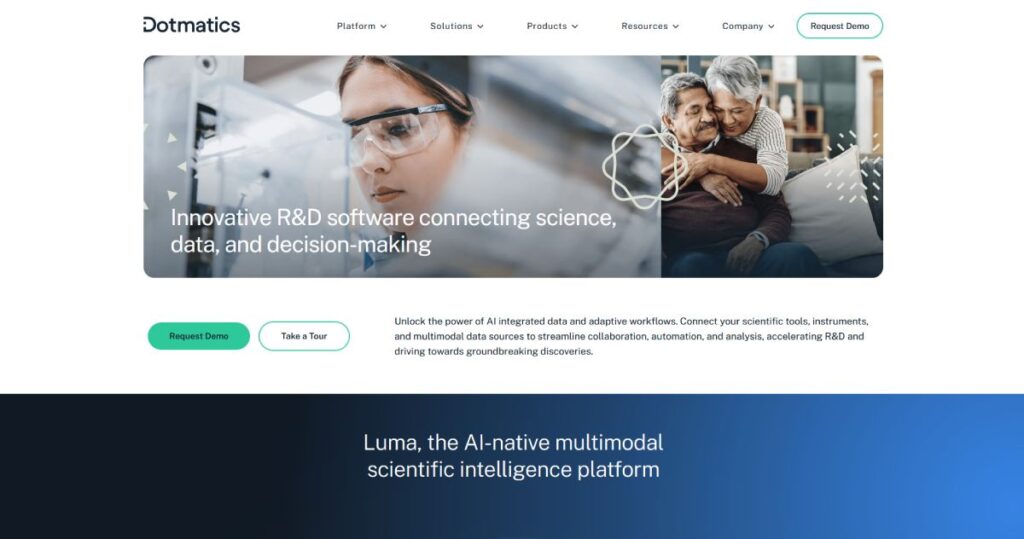
Dotmatics provides a broad suite of scientific informatics tools, including workflow capabilities that support data-driven research environments. Its strength lies in connecting scientific data, analytics, and modeling workflows.
For organizations with complex data pipelines and computational workflows, Dotmatics offers powerful capabilities to automate and manage research processes.
However, like many informatics platforms, its workflow focus is more data-centric than operational. Teams looking to automate lab services, scheduling, and cross-functional coordination may need additional tools to cover operational workflows.
Dotmatics is best suited for data-intensive R&D environments with advanced informatics needs.
5. Smartsheet

Smartsheet is a general-purpose work management platform that some labs adapt for workflow automation. Its flexibility allows teams to build custom workflows without specialized lab software.
While Smartsheet can support basic coordination and task tracking, it lacks lab-specific context. Workflow automation must be manually configured, and visibility into lab resources and scientific processes is limited.
Smartsheet is best suited for teams needing lightweight, customizable workflow tracking, rather than end-to-end lab operations.
Comparison Table: Lab Workflow Automation Software
| Platform | Workflow Scope | Enterprise Scalability | Cross-Team Collaboration | Best Fit For |
| newLab® | End-to-end lab operational workflows | High | Strong | Enterprise R&D labs |
| Benchling | Scientific and experimental workflows | High | Moderate | Research-focused teams |
| Labguru | Lab management and basic workflows | Medium | Moderate | Small to mid-sized labs |
| Dotmatics | Data-driven research workflows | Medium | Moderate | Informatics-heavy R&D |
| Smartsheet | General workflow management | Low | Limited | Lightweight coordination |
Why Smart Lab Platforms Are Replacing Point Solutions
As R&D organizations scale, point solutions struggle to keep up. Each new tool adds another interface, another data silo, and another coordination challenge.
Smart lab software platforms address this by centralizing workflows in a shared operational layer. Instead of stitching together disconnected tools, labs gain:
- Fewer handoffs between systems
- More consistent workflows across sites
- Better visibility into ongoing work
- Easier scaling as teams and programs grow
This shift reflects a broader move toward platform-based lab operations.
Key Takeaways for R&D Leaders
Software to automate lab workflows is no longer optional for modern R&D organizations. The right platform helps labs move beyond fragmented processes toward coordinated, scalable operations. Choosing the right solution depends on whether the organization needs research-centric automation, data-driven workflows, or enterprise-wide operational coordination.
Selecting software to automate lab workflows is a strategic decision that shapes how R&D organizations operate today and scale tomorrow. While many tools offer automation in specific areas, platforms that centralize workflows across scientists, Lab Operations, and IT provide the strongest foundation for long-term growth.
Explore how modern lab workflow platforms support connected, scalable R&D operations.