Pharma and biotech organizations are investing heavily in AI to accelerate R&D. The models are improving. The ambition is clear. Yet in most lab environments, results are still falling short.
The issue is not the models. It is the data foundation they rely on.
When R&D leaders hear “data foundation,” most think of scientific data: experimental results, assay outputs, genomic sequences. That is the bigger challenge, the broccoli everyone knows they need to eat before the AI ice cream. But there is a smaller, often invisible piece underneath it that breaks everything when it is wrong: the operational data that describes the lab environment itself.
Every piece of scientific data is produced in a physical context: on a specific instrument, under defined conditions, within a controlled workflow. If the data describing that context, the equipment records, maintenance histories, calibration states, asset classifications, is incomplete or inconsistent, AI systems cannot identify the right equipment, assess availability or reliability, or route experiments and samples effectively.
AI does not fail because of algorithms. It fails because the environment around the data is not structured. This article is about fixing that layer first.
What “AI-Ready” Really Means in the Lab
An AI-ready lab is not just a software stack. It is an environment where the data describing equipment, resources, and operations is consistent, structured, complete, and governed.
A lab may generate large volumes of scientific data. But without this operational foundation, AI systems cannot interpret or act on it effectively. A model that needs to schedule an experiment on a spectrometer cannot do so if the organization’s spectrometers are named seven different ways across seven different sites, or if three of them exist as duplicate records in three separate systems.
The AI-ready question is not “which model should we deploy?” It is “can any system, human or AI, trust the data describing our lab environment right now?” In most enterprise R&D organizations, the answer is no.
The Real Gap: Data Context, Not Data Volume
Most organizations already have years of lab data. The challenge is not volume. It is structure and context.
The same instrument may be recorded differently across systems and sites. Maintenance history may be missing. Metadata may be unstructured or inconsistent. To an AI model, this is not usable data. It is noise.
Lab data quality at the operational level determines whether downstream systems can reason about the lab at all. Volume without structure produces nothing.
Why Operational Data Matters for AI
Scientific data is always produced in a physical context: on a specific instrument, under defined conditions, within a controlled workflow. If this context is incomplete or inconsistent, AI systems cannot identify the right equipment, assess availability or reliability, or route experiments and samples effectively.
This is what makes operational data the quiet dependency underneath every AI initiative in R&D. The scientific AI model may be excellent. The experimental design may be sound. But if the operational layer cannot tell the model which instruments are available, where they are, and whether they are calibrated and in working condition, the model has nothing reliable to act on.
AI does not fail because of algorithms. It fails because the environment around the data is not structured.
The Role of Data Harmonization
Harmonizing lab asset data is the foundational work that most AI strategies skip. It is not glamorous. It does not make conference slides. But it determines whether the rest of the stack functions. In practice, harmonization means establishing:
- Consistent equipment naming and classification across every site in the organization. A spectrometer in Basel and a spectrometer in Cambridge must be recognized, categorized, and described the same way.
- Complete lifecycle and maintenance records for every asset. Purchase dates alone are not enough. Calibration history, service intervals, downtime events, and current operational status must all be present and structured.
- Structured, governed metadata with consistent field definitions. Free-text notes and optional fields produce data that no system can interpret at scale. Mandatory fields with enforced formats produce data that every system can use.
- A single, trusted representation of each asset. When the same instrument exists as three records in three systems, AI sees three assets. Harmonization produces one canonical record per physical instrument.
This does not mean transforming or standardizing raw scientific datasets. It means ensuring that the operational context around those datasets, the information about the instruments, conditions, and workflows that produced them, is reliable and usable.
When this foundation is in place, AI systems can reason across equipment and sites, optimize utilization, and integrate lab operations into broader workflows. The operational data layer stops being a bottleneck and starts being the infrastructure that everything else builds on.
Harmonization Is an Organizational Decision
Harmonization does not happen because a team installs a new platform. It happens when an organization decides to standardize how lab assets are classified, described, and tracked, and commits to enforcing that standard over time.
The R&D organizations furthest ahead on AI started this work three or four years ago. Forward-thinking IT leaders in large pharma recognized that normalizing infrastructure data was a prerequisite, not a parallel track. They consolidated equipment records and established shared taxonomies while the rest of the industry was still debating whether AI was real.
Those organizations are now running production AI workflows. The ones that skipped this step are rebuilding.
Building the Right Foundation: Where to Start
Creating an AI-ready lab infrastructure is a practical, step-by-step effort. It does not require a new AI platform. It requires discipline about operational data and a decision to treat it as infrastructure.
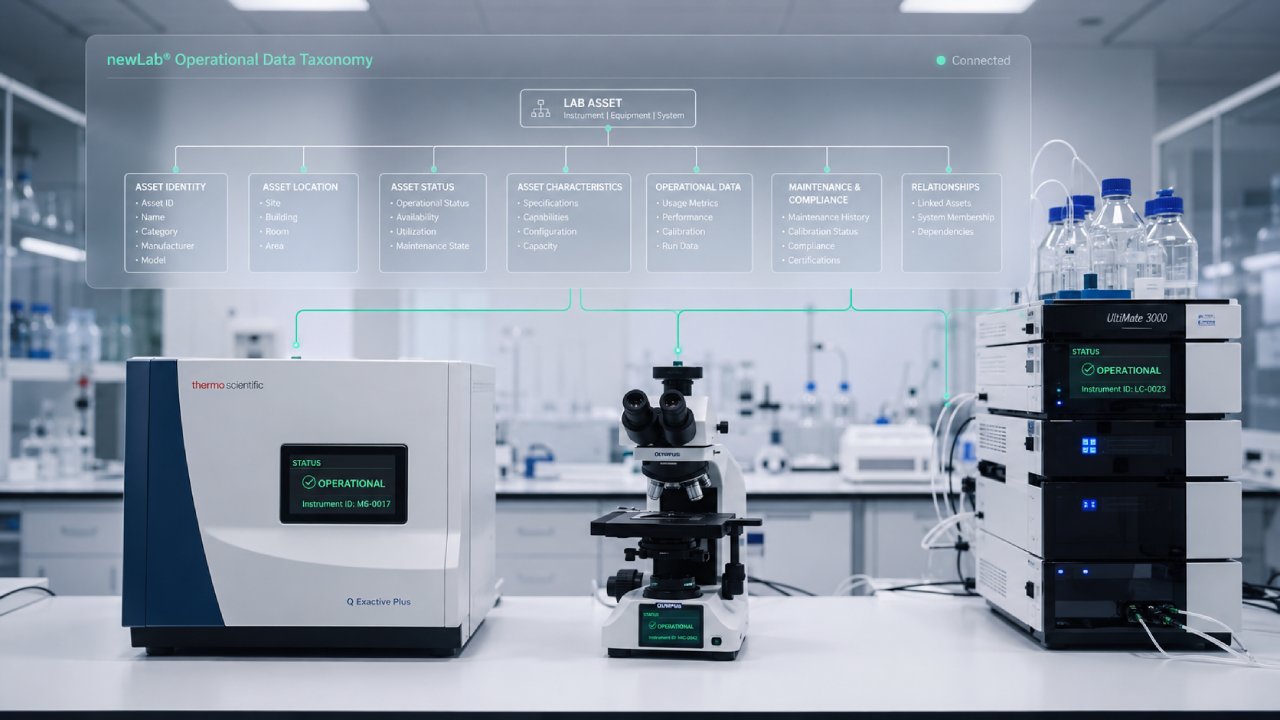
- Audit existing asset data across systems. Pull equipment records from every source in use: asset management, LIMS, ERP, spreadsheets, site-level trackers. Compare how the same instrument is recorded in each. The audit alone will make the scale of the problem visible.
- Define a shared taxonomy for equipment. Agree on how instrument types, subtypes, and models are named and classified. Publish the taxonomy. Make it the standard for every new asset entering any system going forward.
- Enforce mandatory data fields. Decide what every equipment record must contain: identifier, classification, location, ownership, status, maintenance history, calibration data. Optional fields produce incomplete data. Mandatory fields produce usable data.
- Centralize asset records on a governed platform. Rather than adding another standalone system, consolidate lab asset records on infrastructure that IT already supports and governs. This reduces integration complexity and keeps operational data inside the enterprise governance model.
- Establish ownership and governance rules. Define who owns the taxonomy, who reviews new asset types, who resolves naming conflicts, and how changes propagate. Without governance, normalized data drifts back toward fragmentation within eighteen months.
This is not an AI project. It is an infrastructure and data governance decision that makes AI projects possible.
Where newLab® Fits
newLab® provides the infrastructure layer for lab operations, built on ServiceNow. It gives R&D organizations a single governed environment to centralize equipment records across sites, enforce consistent classification and taxonomy, track lifecycle, calibration, and usage data for every asset, and capture structured metadata about lab operations.
This creates a trusted operational context around scientific data. When an AI model receives experimental results, the operational metadata, which instrument produced them, where, when, under what calibration state, is structured, reliable, and traceable. That context is what makes scientific data interpretable to AI.
newLab® does not transform or normalize raw scientific datasets, and it does not replace ELNs or data platforms. Its role is to ensure that data is traceable, contextualized, and connected to the lab environment in which it was generated. ELNs manage experiment design and scientific data capture. newLab® manages the lab infrastructure and operational context. Together, they provide a complete foundation for AI-driven R&D.
From Fragmentation to AI-Ready Operations
When lab infrastructure data is structured and governed, equipment becomes discoverable and comparable across sites. Operational signals become usable by AI systems. Integration across systems becomes reliable rather than brittle.
AI can then operate on a coherent representation of the lab, rather than fragmented inputs scattered across disconnected tools. That is the difference between an AI initiative that delivers and one that stalls at the data preparation stage indefinitely.
Operational Data Readiness: What AI Can and Cannot Work With
| Data Condition | What It Looks Like in Practice | AI Outcome |
| Inconsistent equipment naming across sites | Same spectrometer recorded as “Spec-A,” “SPEC_A,” “UV Spec” in different systems | Model cannot identify or aggregate the asset. Cross-department scheduling fails. |
| Incomplete maintenance and calibration records | Purchase date present, but no service history, calibration data, or uptime tracking | No signal for predicting availability. Experiment routing becomes guesswork. |
| Duplicate entries from manual systems | Same physical instrument created as three records in three separate tools | Capacity counts are inflated. Scheduling conflicts and misrouting follow. |
| Centralized, normalized asset taxonomy | Every instrument recorded under a shared classification with mandatory fields | AI reasons across the full fleet. Scheduling and utilization analysis work. |
| Structured metadata with governed definitions | Enforced formats, consistent vocabulary, complete lifecycle data across every site | AI uses contextual data for experiment routing, feedback loops, and optimization. |
The Foundation Decision
AI in the lab is not just a modeling challenge. It is an infrastructure challenge. Organizations that succeed invest in connected equipment records, structured operational data, and consistent governance before they turn on the AI.
Scientific data readiness is the larger problem and gets most of the attention. But that problem cannot be solved if the operational metadata describing the lab itself is unreliable. Getting AI-ready is a governance decision about infrastructure, made before the first model is deployed.
newLab® enables this foundation, helping labs move toward a truly AI-ready operating model.
To see how the operational backbone for AI-ready R&D works in practice, book a demo with newLab®.
Frequently Asked Questions
What does AI-ready lab infrastructure actually require?
An AI-ready lab requires structured and governed operational data describing equipment, resources, and lab activities. This includes consistent asset classification, lifecycle data, and metadata captured during lab operations. It ensures that AI systems can understand the environment in which scientific data is generated, not just the data itself.
Does newLab® make scientific data AI-ready?
No. newLab® does not transform or normalize raw scientific datasets. Its role is to ensure that scientific data is properly contextualized, by linking it to structured, reliable information about the instruments, conditions, and workflows that generated it. This contextual layer is essential for AI systems to interpret and use scientific data effectively.
Why does lab data quality affect AI performance?
AI systems depend on consistent and interpretable inputs. When equipment records, metadata, and operational data are fragmented or inconsistent, AI models cannot reliably identify assets, understand conditions, or make decisions. High-quality operational data is what enables AI to work effectively in a lab environment.
How do R&D organizations harmonize lab data across sites?
They establish a shared taxonomy for equipment and resources, define mandatory data fields, and centralize asset records on a governed platform. Harmonization focuses on operational and infrastructure data, ensuring consistency across sites and systems. Scientific data itself typically remains managed within ELNs or data platforms.
What is the difference between having a lot of lab data and having usable data?
Volume alone is not enough. Usable data is structured, consistent, and complete, with clear definitions and reliable context. In lab environments, this depends on the quality of the metadata and asset information surrounding scientific datasets.
Where should a lab start when building a foundation for AI?
Start by auditing existing equipment and operational data, defining a shared taxonomy, enforcing mandatory fields, and centralizing asset records on a governed platform. The goal is to create a reliable operational data layer that supports downstream AI and data platforms.
How does newLab® fit with ELNs and scientific data platforms?
newLab® complements ELNs and data platforms rather than replacing them. ELNs manage experiment design and scientific data capture, while newLab® manages the lab infrastructure and operational context. Together, they provide a complete foundation for AI-driven R&D.