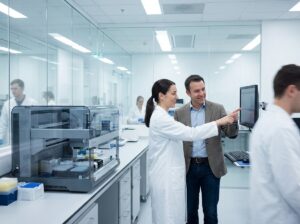
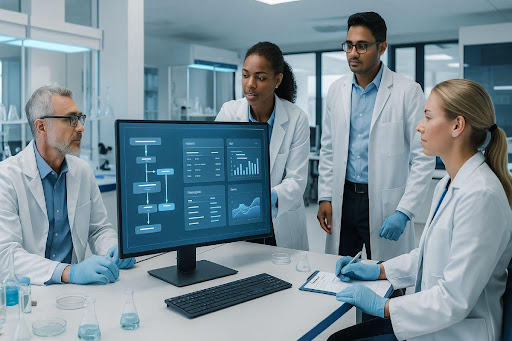
A biotech company can be forty people and already run more high-value instrumentation than a services firm ten times its size. Sequencers, mass specs, flow cytometers, cold storage, all of it bought early, all of it shared, and much of it spread across more than one site before the company has a second product.
That is the operational reality biotechnology lab management software has to handle, and it is why choosing it is harder than the category makes it look.
Most biotech teams solve part of the problem and miss the rest. They buy an electronic lab notebook for the science and a LIMS for the samples, and then find that the equipment, the scheduling, the service requests, and the lifecycle data all still live in spreadsheets and email. The software they bought assumed that layer existed. It did not.
This guide compares the seven platforms most biotech labs actually evaluate, across the three layers that matter: experiments, samples, and operations. It explains what each type is good at, where each one stops, and how to work out which layer your lab is missing. It is written for biotech R&D from startup to enterprise, not as a generic lab-software list, because a biotech lab does not run like other labs.
Biotechnology lab management software manages how a biotech lab runs across three layers: an ELN for experiments, a LIMS for samples, and an operational layer for equipment and scheduling.
The seven platforms here span all three:
- Benchling and Labguru for the science,
- LabVantage, LabWare, and STARLIMS for samples at scale,
- SciNote for budget, and
- newLab® for operations.
What makes biotech different
Three things about biotech labs change what software they need, and generic buyer’s guides miss all three.
Biotech is equipment-intensive from the start. A new biotech buys instruments before it hires a full team, because the science does not happen without them. That capital is significant, teams share it across groups, and someone has to track where it is, whether it works, and who is using it. In a services company, that problem shows up at scale; in biotech it shows up in year one.
The footprint spreads early. A biotech often runs a wet lab in one location, a pilot or process-development facility in another, and a CDMO doing scale-up work in a third, long before it looks like a large company. Each site has its own instruments and its own bookings, and the software has to hold all of them in one place or the coordination falls apart.
The tools change as the company grows. A ten-person startup and a thousand-person organization have different needs, and biotech moves between those states fast. Software that fits at seed can be the wrong tool at Series C, so the question is not only what fits today but what will still fit in two years.
Put those together and a familiar situation appears. A lab manager gets the question: how many instruments does the company own, where are they, and which are under service contract. Answering means walking three sites, opening four spreadsheets that three teams maintain differently, and producing a number that is out of date within a day.
The work is manual, it is error-prone, and it is the symptom of a missing operational layer. An ELN and a LIMS do not fix it, because managing the lab’s equipment was never their job.
The three categories of biotech lab management software
Biotech lab software falls into three categories, and knowing which one a tool comes from tells you what it manages.
- An electronic lab notebook manages the science. It captures experimental design, observations, and results, and it gives scientists a structured, searchable record. Benchling, Labguru, and SciNote all include ELN capabilities. If the problem is that experimental records live in paper notebooks or scattered files, this is the layer that fixes it.
- A LIMS, a laboratory information management system, manages samples and the data attached to them. It tracks a sample from registration through testing to reporting, handles inventory, and stores structured results. LabVantage, LabWare, and STARLIMS are enterprise examples. If the problem is high-volume sample tracking, this is the layer.
- The operational layer manages the lab itself: the equipment, the scheduling, the service requests, and the lifecycle data around the science. It keeps instruments booked, serviced, and accounted for across sites.
newLab® is the example here. In most biotech operations, this layer does not exist as software yet, which is why the equipment questions are the ones that stay on spreadsheets. The related problem of automating the workflows that run on top of that layer is covered in our guide to lab workflow automation tools.
The three overlap at the edges, and some platforms bundle two of them, but they answer different questions. A biotech lab usually needs more than one, and the buyer’s job is to see which one is missing.
The 7 best biotech lab management platforms
Here are the seven platforms biotech labs most often shortlist, grouped by the layer each one leads in. Each profile covers what it is, its biotech fit, one real strength, and where it stops.
1. newLab®
newLab® leads on operations rather than science. It manages the equipment, scheduling, service requests, and lifecycle data that keep a biotech lab running, and it runs natively on ServiceNow, so it lives inside the IT stack most biotech organizations already operate rather than beside it.
It fits biotech that has the science handled and the operations scattered across spreadsheets, shared calendars, and email.
What it does not do is deliberate: newLab® does not capture experiments or manage samples, because it works alongside the ELN and LIMS that do. The next section covers how it works in detail.
2. Benchling
Benchling is the platform most biotech R&D teams know first. It combines an electronic lab notebook with LIMS features in a cloud system centered on molecular biology, and it is strong on experiment design, sequence and construct management, registration, and collaboration between scientists. For a biotech doing biology-heavy work, cell and gene therapy or antibody engineering, it often becomes the center of the scientific stack.
Part of why teams adopt it is the interface. Benchling feels modern in a category where a lot of software does not, and scientists tend to use it without the resistance heavier systems provoke.
Its strength is scientific, and so is its boundary. Benchling coordinates the experiment and the data around it; the operational work of running the lab, servicing instruments, booking shared equipment across sites, and handling service requests sits outside what it manages. Teams that need that usually pair Benchling with a separate operational tool. For a closer look at Benchling and the platforms labs compare against it, see our comparison of Benchling competitors and alternatives.
3. Labguru
Labguru pairs an ELN with LIMS and inventory features in one web-based system, and it is quick to set up. It suits smaller biotech and academic-adjacent teams that want the science, the samples, and the inventory in one place without a months-long implementation, which is a real advantage for a lab that needs something working now.
The trade-off arrives with scale. Labguru handles a single site or a growing team well, but coordinating workflows across several sites and integrating deeply with enterprise systems gets harder as the organization grows. Biotech that crosses into multi-site, enterprise territory often starts looking at heavier platforms at that point, while Labguru remains a strong fit for the stage below it.
4. LabVantage
LabVantage is an enterprise LIMS with deep adoption across biotech and pharma. It manages samples, inventory, and results at volume, and it holds up across large, multi-site operations that need real depth in sample management and reporting. For a biotech that has grown into serious sample throughput, it brings structure a lighter tool cannot.
That depth is enterprise-grade, and the commitment matches it. Implementation is a project measured in months and needs administrators to run and maintain it. LabVantage earns its place in organizations with the scale and the resources to support it, rather than in an early-stage lab that needs a system live in weeks. It is a platform you grow into, not one you start with.
5. LabWare
LabWare has anchored the enterprise LIMS market for decades, and it is among the most configurable platforms in the category. It bends to match complex sample and data workflows across many sites and many sample types, which is why large biotech and regulated production environments choose it when they need a system shaped precisely to their processes.
Configurability is the strength and the cost at once. Implementations run long, and the platform needs ongoing configuration and administration as processes change. A startup or mid-market lab rarely needs that much machinery, and the effort only pays off at the scale and complexity that justify it. LabWare fits the large end of biotech, not the fast-moving early end.
6. STARLIMS
STARLIMS, owned by Abbott, comes from the regulated world: a LIMS focused on data integrity and sample management, with a long history in pharma, clinical, and diagnostics. For biotech operating under those conditions, it brings depth and a track record newer tools cannot match.
It is an enterprise system, and it carries the weight that comes with that. Deployment and configuration are heavier than an early-stage or mid-market biotech is likely to want, and the platform assumes the resources of a larger organization. STARLIMS fits large, established biotech more than lean teams that need to move quickly, and it tends to appear on shortlists where sample depth is the deciding factor.
7. SciNote
SciNote is an electronic lab notebook with open-source roots and a free tier, which makes it a common first system for small and budget-conscious biotech. It covers core documentation, protocols, and basic inventory without a large upfront commitment, and a lab can start on the free tier and add paid features as it grows.
Its limit shows at scale. Larger organizations that need advanced administration, deeper integrations, and enterprise controls tend to outgrow what SciNote offers. It fits best where keeping costs down matters more than breadth of features, which describes a lot of early biotech before the first major funding round.
7 biotech lab management platforms compared
What each platform is best at, the biotech it fits, and where it stops.
| Platform | Type | Biotech best-fit | Notable strength | Where it stops |
|---|---|---|---|---|
| newLab® | Operational layer | Biotech with operations scattered across sites | Equipment, scheduling, and service requests on ServiceNow | Does not capture experiments or manage samples |
| Benchling | ELN + LIMS | Biology-heavy R&D teams | Experiment and molecular biology workflows | Operational work outside the science |
| Labguru | ELN + LIMS + inventory | Startups and smaller teams | Fast onboarding, all-in-one | Multi-site scale and deep integration |
| LabVantage | Enterprise LIMS | Large multi-site biotech | Sample management at volume | Long implementation; operations secondary |
| LabWare | Enterprise LIMS | Large and regulated biotech | Deep configurability across sites | Long, costly implementation |
| STARLIMS | Enterprise LIMS | Large, regulated biotech | Data integrity, long track record | Heavy to deploy for smaller labs |
| SciNote | ELN | Small, budget-conscious biotech | Free tier, open-source roots | Enterprise controls and integrations at scale |
How to evaluate biotechnology lab management software
The shortlist depends on a few biotech-specific decisions. Work through these before you compare products.
- Find the layer you are missing. Decide which of the three you already have, an ELN for experiments, a LIMS for samples, an operational layer for equipment and scheduling, and which one is still on spreadsheets. Most biotech labs are missing the operational layer and do not realize it until the equipment questions pile up.
- Weigh how equipment-intensive and multi-site you are. Count the shared, high-value instruments and the sites they sit across. The more of both, the more the operational layer matters, and the sooner it matters.
- Check integration with what you keep. You are not replacing everything, so confirm each option connects to the ELN, LIMS, and IT systems you are keeping. A tool that cannot exchange data with the rest of the stack adds a silo instead of closing one.
- Match the tool to your stage and your next stage. A platform that fits a ten-person startup can be wrong at Series C. Ask not only what fits now but what will still fit after the next round of growth and the next site.
- Look at configurability and who maintains it. Ask whether your team can adjust workflows themselves or whether every change needs a developer or a vendor ticket. In a small biotech with no dedicated admin, that difference decides whether the tool gets used.
- Price the whole thing. Add implementation, configuration, training, and internal time to the license fee. Enterprise LIMS platforms in particular run into six figures and months of setup, so the sticker price and the real first-year cost are far apart.
Where newLab® fits: the operational layer
Every platform above manages part of a biotech lab. An ELN manages the experiments. A LIMS manages the samples. None of them manages the lab itself: the instruments, the bookings, the repairs, and the records that tie them together. In most biotech operations, that operational layer is the one that never became software, and it is where newLab® works.
newLab® runs natively on ServiceNow. For a biotech IT team that already uses ServiceNow for incident response and IT asset management, that changes the math: one platform, one identity layer, one set of reporting tools, rather than another standalone system connected by API calls. It manages the operational layer and connects to the scientific tools around it.
- newLab® keeps one record for every instrument across every site, with its location, service status, and cost center, so lab, IT, and finance stop reconciling separate versions of the same asset list. This is where lab equipment and resource management moves out of spreadsheets.
- It runs equipment scheduling and booking against live equipment status, so a shared instrument is not double-booked and a reservation does not land on something down for service.
- It automates lab service requests like imaging, sample prep, and media preparation, so each request has an owner and a status instead of sitting in an inbox.
- newLab® does not capture or store scientific data, does not drive instruments, and does not replace your ELN or LIMS. It manages the operational layer and integrates with tools like Benchling and Labguru rather than competing with them.
The division is clean. An ELN manages experiments, a LIMS manages samples and lab data, and newLab® manages the operational layer around both. For biotech that is scaling fast and spreading across sites, that layer is usually the missing piece, and the pharma and biotech operations it supports are exactly the ones where equipment and coordination break down first.
Common mistakes biotech teams make when buying
A few patterns show up again and again when biotech labs buy this software, and they are worth avoiding.
The first is buying for the science and forgetting the operations. A team evaluates ELNs carefully, picks a good one, and two years later is still tracking a hundred instruments in a spreadsheet because nobody scoped the operational layer. The science got a system; the lab did not.
The second is buying enterprise software too early. An enterprise LIMS is powerful, but a fifteen-person biotech that commits to one often spends a year configuring a platform built for an organization ten times its size, and the tool slows the lab down instead of speeding it up. The right tool for the stage beats the most powerful tool on the list.
The third is treating multi-site as a later problem. Biotech spreads across sites earlier than teams expect, and software chosen for one location often cannot hold two. Assuming a single site when a second is already on the roadmap forces a migration that a little foresight would have avoided.
The fourth is skipping the real test. A polished demo proves the vendor can run their own example, not that the tool fits your workflows. The teams that choose well run their own processes through the software before they sign.
How to run the selection
Once you know the layer you are missing and have a shortlist, the selection is straightforward. Write down three to five requirements you will not compromise on, and be specific: which systems it must integrate with, how many sites it must cover, who needs to use it.
Take those into a demo and run one of your own workflows through each tool, not the vendor’s prepared example. Ask each vendor for biotech references at your size and stage, and ask those teams what surprised them after go-live. Then weight your requirements before you compare, so the decision rests on what your lab needs rather than on whichever demo was smoothest.
Which layer is your lab missing?
Buying biotechnology lab management software is less about finding the best product than about finding the layer your lab is missing. Decide whether the gap is experiments, samples, or operations, and the shortlist narrows quickly: an ELN like Benchling or a budget option like SciNote for the science, an enterprise LIMS like LabVantage, LabWare, or STARLIMS for samples at scale, and an operational platform like newLab® for the equipment, scheduling, and service requests around them.
For most biotech, the science is already handled, and the operational layer is the one still running on spreadsheets and email. It is also the layer that breaks first, because biotech is equipment-intensive and multi-site earlier than almost any other kind of company.
If that is the gap in your lab, book a demo, and we will run one of your own workflows through newLab® on ServiceNow, alongside the ELN and LIMS you already use.
FAQs
What is biotechnology lab management software?
Biotechnology lab management software manages how a biotech lab runs across three layers: an electronic lab notebook for experiments, a LIMS for samples and data, and an operational layer for equipment, scheduling, and service requests. Some platforms cover one layer, some bundle two. Which one you need depends on where your lab still relies on spreadsheets and email.
What is the difference between a LIMS and an ELN?
An ELN, an electronic lab notebook, manages the science: experimental design, observations, and results. A LIMS, a laboratory information management system, manages samples and the data attached to them, from registration through testing to reporting. Many biotech labs run both, because they solve different problems, and add an operational platform for the equipment and scheduling neither one manages.
What is the best lab management software for a small biotech?
It depends on the layer you need. For the science on a budget, SciNote offers a free tier and Labguru is quick to onboard. For the operational layer, newLab® manages equipment and scheduling from day one, which matters because biotech is equipment-intensive early. Start by naming the layer that is causing the most friction.
Do biotech startups need lab management software from day one?
For the operational layer, often yes. A biotech buys expensive, shared instruments before it hires a full team, and tracking where they are, whether they work, and who is using them becomes a problem in year one. The science can wait for an ELN longer than the equipment can wait for a system to manage it.
Can biotechnology lab management software be cloud-based?
Yes. Most modern options are cloud-based, including Benchling, Labguru, and SciNote on the scientific side and newLab® on the operational side. Cloud delivery matters for biotech because labs spread across sites early, and a shared system has to reach every location. Confirm each vendor’s deployment and data-hosting details before you decide.
How does newLab® fit with an ELN or a LIMS?
newLab® manages the operational layer around the science, the equipment, scheduling, and service requests, and integrates with the ELN and LIMS you already run rather than replacing them. An ELN keeps the experiments, a LIMS keeps the samples, and newLab® keeps the lab itself running. The three cover different layers of the same lab.
Is newLab® a LIMS?
No. newLab® is not a LIMS and does not manage samples or scientific data. It is the operational layer on ServiceNow for equipment, scheduling, and service requests, and it works alongside whichever LIMS or ELN a biotech lab uses.