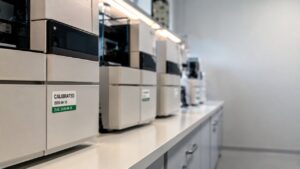

A finance controller sends your team a spreadsheet. It lists forty pieces of lab equipment tied to the fixed-asset register, and the request is simple: confirm which of these still exist, and tell us where each one sits. You read it, and you already know the honest answer will take days to assemble.
This is the reconciliation gap, and it is the single biggest operational headache in most pharma R&D environments. Not because the question is hard, but because no one place holds the answer. Equipment records live in the ERP, in per-site spreadsheets, in LIMS, in booking calendars, and in the heads of people who have worked a given site for years.
This article is about lab asset tracking and the finance reconciliation gap it exposes. It is not about calibration workflows, data normalization theory, or AI readiness. It is about a controller asking whether an asset still exists, and a lab that cannot answer fast.
The finance question your lab can’t answer fast
Two versions of the same problem show up again and again.
- The first: assets sit on the books that may or may not be on the floor. Finance capitalized a spectrometer four years ago, it moved between two sites since, and no record followed it. Finance still carries it. Whether it physically exists is anyone’s guess.
- The second runs the other direction. Equipment sits on the floor that never made it onto the register at all. A grant-funded analyzer arrived, a technician installed it, and it started running experiments before procurement closed the loop. It works every day. On paper it does not exist.
Both versions produce the same result when finance asks its question. Someone has to walk the floor, cross-check three or four systems, call the sites, and build an answer by hand. The question is simple to ask. It is expensive to answer.
When the asset register and the lab disagree
The register is only as accurate as the last time someone reconciled it against reality, and in a multi-site R&D operation that reconciliation rarely happens on a schedule. Assets move. Teams retire instruments and leave them in a corner for a year before anyone updates the record.
New equipment arrives through different channels at different sites. The register drifts from the floor a little more each quarter, and no one notices until finance forces the comparison.
Why does equipment inventory reconciliation take days
The delay is not a discipline problem. It is a structural one. Equipment inventory data does not sit in one system that finance can query. It sits in at least four, and none of them reconcile against the others.
The ERP fixed-asset register holds the financial view: acquisition cost, capitalization date, depreciation schedule. It rarely holds current location or working condition. Per-site spreadsheets hold what each lab team tracks for itself, in whatever format that team settled on years ago.
LIMS and instrument logs hold operational detail for the instruments they cover, and nothing for the ones they do not. Booking calendars show what people schedule, which is a rough proxy for what exists but not a reliable one.
Each source uses its own naming. One site logs a mass spectrometer by manufacturer and model. Another logs the same class of instrument by an internal asset tag. A third calls it by the nickname the team gave it. Duplicate records accumulate. Retired equipment lingers in systems no one prunes. Confirming what actually exists means opening every source, matching the names by hand, and resolving the conflicts one at a time.
Where equipment inventory data hides:
- The ERP fixed-asset register. This is the system finance trusts, and it holds acquisition cost, capitalization date, and depreciation schedule for every asset on the books. What it does not hold is current location, working condition, or whether the asset physically exists today. Reconciliation stalls here because the financial record was never built to describe the lab floor.
- Per-site spreadsheets. Each site keeps its own equipment list in whatever structure the local team built, with columns, naming, and update habits that differ from every other site. These files hold real detail, but they do not talk to each other or to the register. Pulling a fleet-wide answer means collecting every version and manually resolving the differences between them.
- LIMS and instrument logs. These systems track operational detail for the instruments they cover, which is useful and also partial. They say nothing about equipment outside their scope, and their teams built them to run experiments, not to answer whether an asset still sits on the register. Finance cannot read them as an inventory source without translation.
- Booking calendars and tribal knowledge. What people schedule hints at what exists, and what a ten-year veteran remembers fills the gaps the systems miss. Neither is a record you can hand to a controller. When the answer to “do we still own this” lives in someone’s memory, reconciliation depends on that person being at their desk.
The cross-site visibility gap in pharma asset management
Stack that problem across five sites and it changes character. Now it is not just that each system disagrees with the others. It is that each site runs its own version of the disagreement, and no one at headquarters can see across all of them at once.
Every site names its equipment its own way, logs it in its own tools, and stores its records on its own drive. There is no consolidated view of the fleet, because there is no shared structure to consolidate it into. Ask what the organization owns across every location, and the honest answer is that no single person or system knows.
Walk into most pharma and biotech operations and this is what you find: spreadsheets everywhere, no consolidated view, and teams so used to the arrangement that they no longer register it as a fixable problem. The mess became the baseline. It costs real money, and no one carries a line item for it.
The cost shows up in three ways. One site buys an analyzer that another site already owns and underuses, because neither could see the other’s inventory. Expensive equipment sits idle at one location while a team elsewhere budgets to purchase the same thing.
Assets written off years ago still sit physically in a lab, occupying space, power, and service contracts no one revisits. Pharma asset management breaks down at exactly the point where a headquarters team needs one view of what every site owns and cannot get it.
What reliable lab asset tracking requires
Reliable lab asset tracking is not complicated to describe. It is hard to build, but the requirements are clear, and any system that closes the reconciliation gap has to meet them.
It needs one record per asset, so a single row represents a single physical thing and everyone queries the same row. It needs a shared taxonomy across sites, so the same class of instrument carries the same name whether it sits in Basel or Boston.
It needs current location and ownership on that record, not last year’s location. It needs lifecycle state tracked all the way through disposal, so a retired asset reads as retired instead of lingering as live. And it needs a view finance can actually read, in terms a controller recognizes, without a translation layer between the lab’s language and the register’s.
Meet those five, and the days-long reconciliation collapses into a lookup. Miss any one, and the gap reopens.
How newLab® gives finance one asset record to reconcile against
newLab® is the operational backbone for lab asset data, built natively on ServiceNow. It centralizes and structures the operational records that describe the lab environment, and it holds each asset as one governed record that finance, procurement, and lab operations all read from the same place.
That record carries what reconciliation actually needs. Identity, so the asset is unambiguous. Location and ownership, kept current as equipment moves between sites. Lifecycle state, tracked from acquisition through disposal, so retired equipment reads as retired.
Maintenance and calibration status, held as operational metadata on the record rather than scattered across separate logs. Across every site, a shared asset taxonomy means the same instrument class carries the same name, so headquarters sees one fleet instead of five local versions of it.
When finance asks whether an asset still exists and where it sits, the answer comes from one record instead of four systems and a phone call. The ERP register reconciles against a single source of asset records rather than a line-by-line manual comparison across disconnected files.
newLab® does not connect to scientific instruments, and it does not extract or store raw scientific data. It structures the operational records that describe each asset: what it is, where it sits, who owns it, and where it stands in its lifecycle.
That boundary matters for how newLab® fits the rest of the stack. ELNs manage experiment design and scientific data capture. newLab® manages lab infrastructure and operational context. newLab® connects to ERP, LIMS, and ELN systems rather than replacing them, so the asset record stays consistent with the financial register on one side and the experimental systems on the other.
| Reconciliation task | Without a single asset record | With newLab® on ServiceNow |
| Confirm an asset still exists | Chase spreadsheets, ERP, and site logs by hand | Check one governed record with current status |
| Locate an asset across sites | Email each site and wait for replies | See site and location in the shared fleet view |
| Match the ERP register to reality | Line-by-line manual comparison | Reconcile against one source of asset records |
| Flag retired or disposed equipment | Often missed, register stays inflated | Lifecycle state marks disposal so records match reality |
| Answer finance’s “do we own this” query | Days of cross-team coordination | A single record to verify against |
What one governed asset record changes for reconciliation:
- Existence checks resolve from one record. When a controller asks whether an asset still exists, the answer sits on a single governed record with current status, not across four systems that each hold part of the picture. The question that used to trigger a floor walk becomes a lookup.
- The full fleet becomes visible in one place. A shared taxonomy across sites means headquarters sees every location’s equipment in one consolidated view, under consistent naming. Duplicate purchases and idle assets surface because someone can finally see the whole fleet at once.
- Retired and disposed assets stop haunting the register. Lifecycle state tracked through disposal means a retired asset reads as retired, so the register stops carrying equipment that left the floor years ago. Finance reconciles against records that match physical reality instead of a list that drifted.
- Finance and lab operations work from the same record. Both sides query one source rather than maintaining separate versions that disagree. The reconciliation conversation stops being a negotiation between two incomplete lists and becomes a check against one.
Go back to the controller’s spreadsheet from the start. The request has not changed: confirm which of these forty assets still exist, and say where each one sits. What changes is where the answer comes from. Instead of days spent walking floors and cross-checking systems, the answer reads off one governed record, current, consistent across sites, and legible to finance without translation.
The reconciliation gap is not an AI problem or a data-theory problem. It is a question of whether one place holds the truth about what your lab owns. newLab® gives you that place, on the ServiceNow stack your IT organization already runs.
See how newLab® closes the reconciliation gap for your equipment fleet. Book a newLab® demo.
FAQ
What is lab asset tracking in pharma R&D?
Lab asset tracking is keeping an accurate, current record of every piece of lab equipment: what it is, where it sits, and its status across sites. In pharma R&D that record has to hold up when finance, procurement, and lab operations all query it at once.
Why does manual equipment inventory reconciliation take so long?
Equipment inventory data lives in spreadsheets, ERP records, LIMS, and calendars that no one reconciled against each other. Confirming what exists and where means chasing each source by hand, which stretches a simple question into days.
What causes the cross-site visibility gap in pharma asset management?
Each site names, logs, and stores equipment records its own way, so no single view reflects the full fleet. Pharma asset management breaks down when a headquarters team cannot see, in one place, what every site actually owns.
Does newLab® replace our ERP asset register, LIMS, or ELN?
No. newLab® gives lab operations one governed asset record on ServiceNow and connects to ERP, LIMS, and ELN rather than replacing them, complementing the experiment and scientific data those tools already hold.