

Labguru does a lot for one lab. It puts an electronic lab notebook, LIMS features, and inventory in a single system, and most teams get it running without a long implementation project. So when a lab starts shopping for a Labguru alternative, the reason for leaving matters more than any feature list.
Labs leave for two different reasons. Some want a different tool for the same job: a notebook with deeper molecular biology tools, stronger procurement, or a lower bill. Others are outgrowing Labguru as they add sites, and their problem shows up somewhere else. Two sites book the same instrument class on separate calendars, and a failing centrifuge sits behind a service request nobody owns. The equipment list that worked for one building stops making sense across three.
This guide covers both groups. It profiles six Labguru competitors that do the same job differently, plus one platform for the operational layer that multi-site labs run into. It is not a two-way head-to-head and not a generic ranking of ELNs. Each profile measures the alternative against what Labguru does today.
The best Labguru alternatives in 2026 depend on why you are leaving. For a peer ELN or LIMS, compare Benchling, SciNote, Genemod, Scispot, and LabArchives. For inventory and ordering, look at Quartzy. For equipment, scheduling, and service requests across sites, newLab® manages the operational layer on ServiceNow and runs alongside your ELN.
Why labs look for a Labguru alternative
BioData’s Labguru combines an ELN, LIMS functions, and inventory management in one platform, with add-on modules for equipment management, automation, and data dashboards. It has a reputation for ease of use, and a small biotech can move off paper notebooks and freezer spreadsheets quickly.
Its LIMS functions are strongest at knowing where samples and reagents are and which instrument ran what. A lab running high-throughput testing against fixed methods will usually want a dedicated LIMS. For a single research lab, that mix covers most of what the team needs.
- The first group of leavers hits a depth limit in one area. A protein engineering team wants sequence design and a biological registry. A lab manager buried in purchase requests wants a real procurement tool, and an academic group wants the same basics for less money. Each of these is a tool swap, and the peers below cover them.
- The second group hits a coordination limit. Labguru does include equipment booking, maintenance logs, and calibration scheduling, and inside one lab they work. The strain appears when the organization runs several sites. The same HPLC model ends up with three naming conventions.
A scientist cannot see that an identical instrument sits idle in the next building. Repair tickets go to facilities and IT teams who often work in ServiceNow and never open the ELN. A bigger ELN rarely solves these problems, because the people who fix, track, and pay for instruments do not work in a notebook.
How to choose a Labguru alternative
Start with the reason you are leaving, then test every shortlist against these points.
- Name the layer that is failing. An ELN records experiments, a LIMS moves samples through defined workflows, inventory software tracks reagents and orders, and operational software manages equipment, bookings, and service requests. Labguru covers parts of all four, so decide which one is breaking before you compare vendors.
- Plan for the number of sites you will run in two years. An inventory list that works for one lab becomes useless across three if each site names and locates items differently. Ask every vendor how it handles shared instruments, cross-site permissions, and one record per asset across locations.
- Weigh ease of use against depth. Labguru built its reputation on ease of use, and scientists notice every extra click a replacement adds. Deeper or more configurable platforms repay the setup effort only if your team will use what that depth buys.
- Check how each option connects to the systems you keep. Most labs hold on to at least one incumbent, whether an ELN, an ERP for purchasing, or ServiceNow for IT assets. A tool that trades data through a weekly CSV export will produce a second source of truth within a quarter.
- Count the full cost. Migrating years of notebook entries, retraining scientists, and configuring the new system often costs more than the first year of licenses.
The 7 Labguru alternatives
Roundups of top lab management systems usually mix ELNs, inventory tools, and operational software. Here, the first six compete with Labguru directly, and the seventh covers a different layer. For the wider ELN field, see our breakdown of Benchling alternatives.
1. Benchling
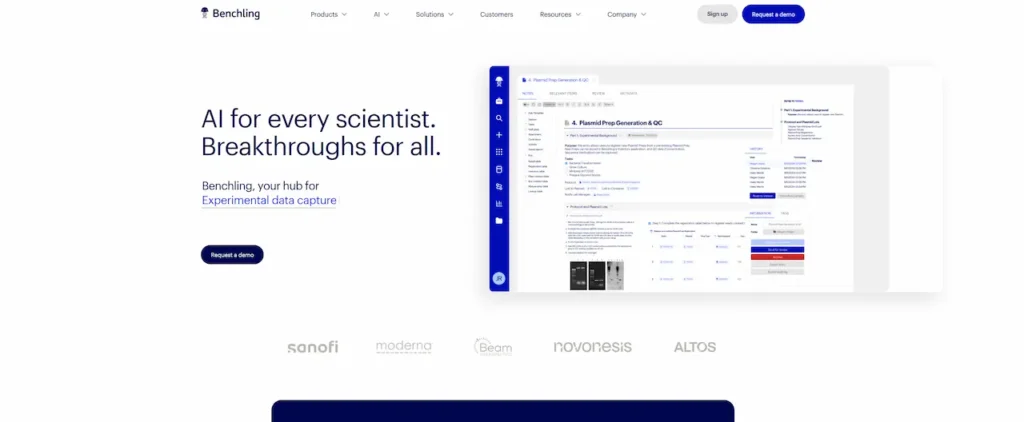
Benchling is a common step up from Labguru for biotech teams whose work centers on molecular biology. It combines an ELN with a registry for biological entities, sample tracking, workflow tools, and molecular biology features. A team that designs constructs, runs CRISPR edits, or engineers proteins will find those tools deeper than Labguru’s.
Benchling asks more of the organization in configuration and administration, and it tends to cost more than Labguru for a team of the same size. G2 reviewers who compared the two rated Labguru easier to use and administer, though they gave Benchling the edge on initial setup. For a lab that mostly needs a clean notebook and a freezer map, Benchling is more platform than the work requires. Our Benchling vs Labguru comparison covers the head-to-head.
2. SciNote
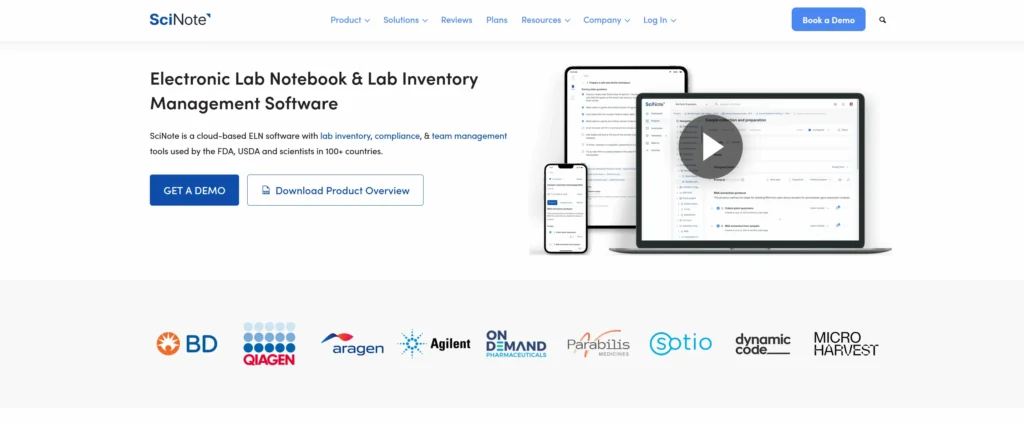
SciNote is one of the peers that shows up most often on Labguru shortlists, particularly in academic and government labs. It organizes work in a projects, experiments, and tasks hierarchy, with inventory for samples and reagents and team management in one ELN. It covers similar all-in-one ground to Labguru, usually at a lower cost, and SciNote has historically offered a free plan.
SciNote’s LIMS depth is thinner than Labguru’s, and labs running branching, multi-stage protocols sometimes find its fixed structure harder to adapt than they expected. E-signatures and other advanced controls sit in its higher plan tiers, so compare tiers line by line.
3. Genemod
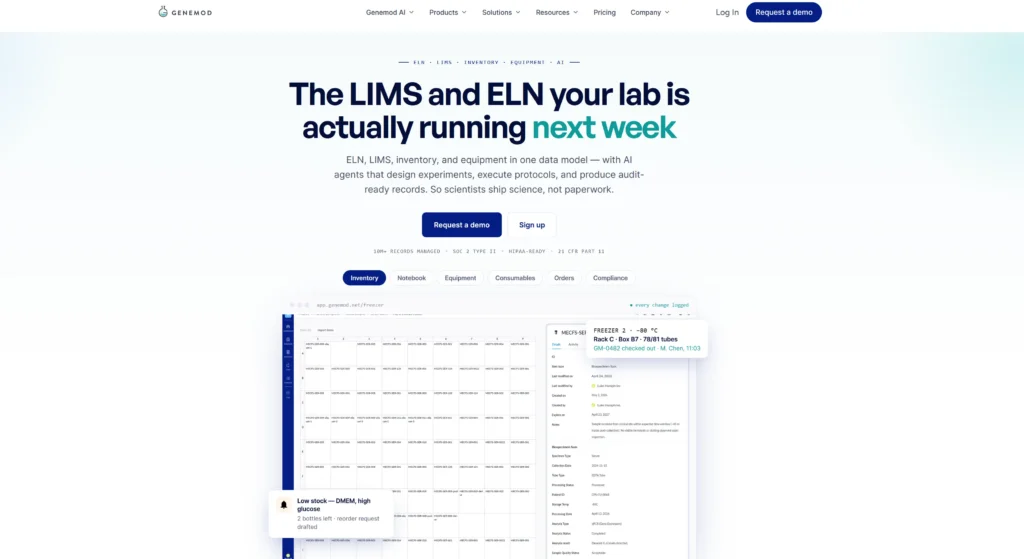
Genemod competes with Labguru most directly on ease of use. It puts an ELN, LIMS functions, and inventory in one data model. Its virtual freezer shows each sample’s exact rack, box, and slot, so a scientist can locate a tube before opening the freezer door. For teams that want software similar to Labguru with a newer interface, Genemod belongs on the shortlist, and the vendor pitches deployment in days.
Genemod markets itself mainly to biotech startups and academic groups, so ask for references at your size, particularly if you run several sites or need close ties to enterprise systems. The vendor now puts AI agents at the front of its marketing, pitched as help with protocol writing and experiment write-ups. Test those features against your own workflows before you count them in the decision.
4. Scispot
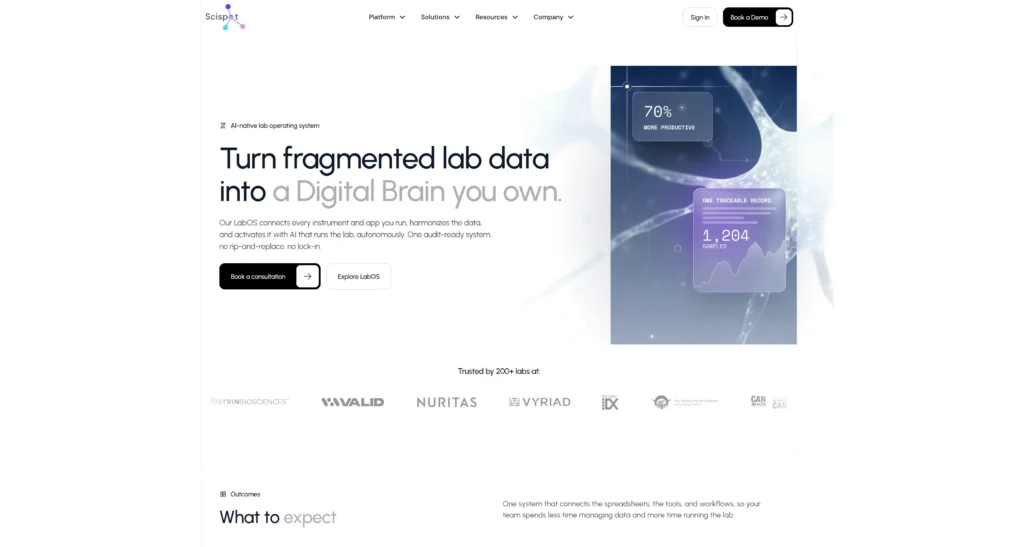
Scispot takes the opposite approach to Labguru. Instead of an out-of-the-box notebook, it gives teams configurable building blocks: Labsheets, which hold LIMS records in a grid layout, plus an ELN, workflow tools, and an integration layer called GLUE. The company advertises hundreds of prebuilt instrument connectors. For labs comparing alternatives to Labguru and LabArchives for lab automation, Scispot is a natural first stop.
A configurable system rewards teams with a data engineer or a technical lab manager who will design the schemas and automations and keep them running. A lab that chose Labguru because it worked on day one may find Scispot demands more setup than the team has time for.
5. LabArchives
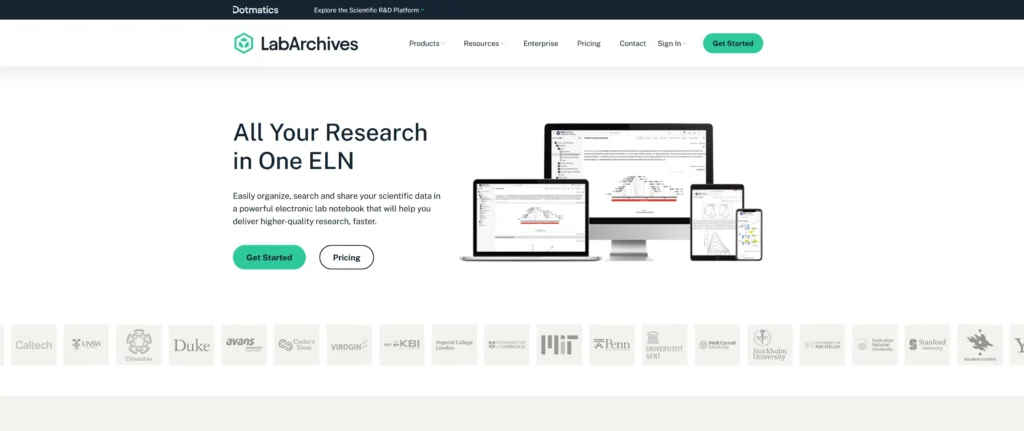
LabArchives is a cloud ELN built around documentation and collaboration, with a large footprint in universities and research institutes. The NIH licenses its research products agency-wide. The ELN has a free tier, and LabArchives sells Inventory and Scheduler as separate products, so a group can start with the notebook and add pieces later.
Compared with Labguru, LabArchives is simpler and usually cheaper, and it covers less. It has no LIMS module, and inventory and scheduling arrive as add-ons. For a principal investigator moving a group off paper, that is often enough. A lab that needs sample workflows tied tightly to experiments will find it thin.
6. Quartzy
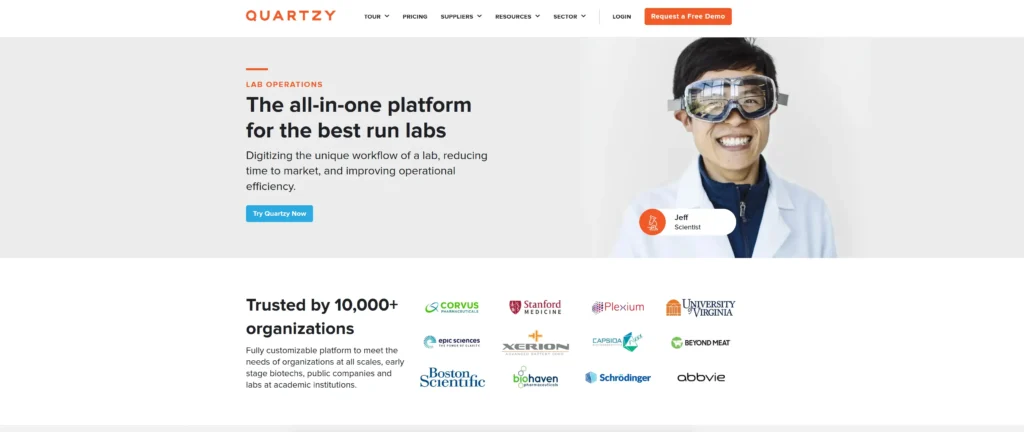
Quartzy is lab inventory management software organized around ordering, and it has no notebook component. Scientists pick products from a wide supplier catalog, a lab manager approves the request, the order goes out, and the item lands in inventory when it arrives. For labs whose real bottleneck is purchasing, Quartzy goes further into procurement than Labguru’s inventory module does.
Quartzy does not record experiments or move samples through LIMS workflows, so labs that use it typically pair it with a separate ELN. Check which procurement features sit in the base plan and which cost extra. For the full picture, see our Quartzy vs Labguru vs newLab® comparison.
7. newLab®
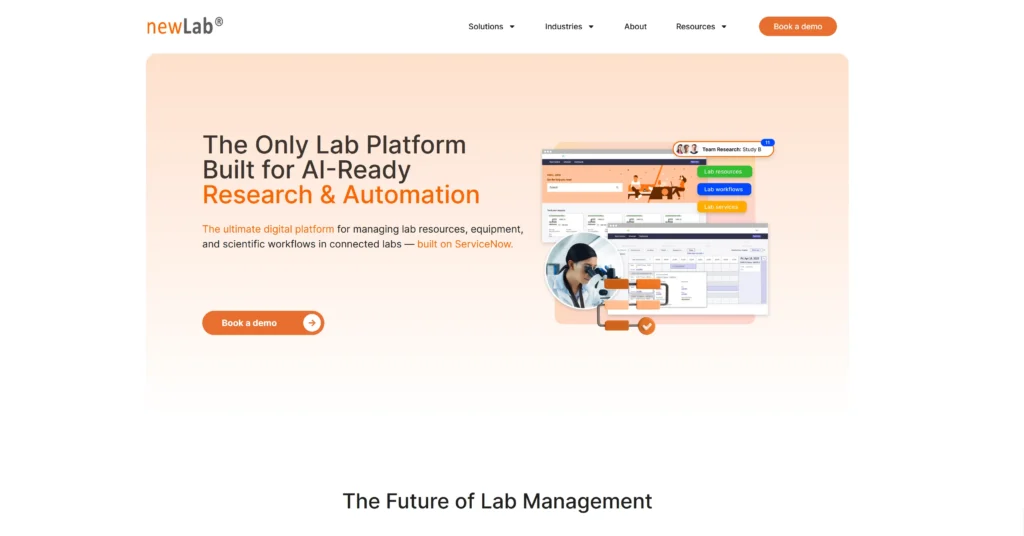
newLab® is not a like-for-like Labguru replacement. It does not capture experiments, manage samples, or track reagents the way an ELN does. It belongs on this list for the second group of leavers: labs outgrowing Labguru because they now run several sites and coordination is breaking down.
Those labs often assume they need a bigger ELN. Their daily failures look different. A shared confocal microscope gets two bookings for the same morning because each site keeps its own calendar, and a repair request for a -80°C freezer waits in an inbox with no owner.
When finance asks how many plate readers the organization owns, three sites give three answers. Each of those failures sits in the operational layer. newLab® is the operational backbone for that layer, and it runs natively on ServiceNow, where IT and facilities teams often track assets and tickets already.
An ELN like Labguru manages the science: experiment records, protocols, and results. newLab® manages the operational layer around it. It connects to ELN and LIMS systems through APIs and runs alongside Labguru or any of the six alternatives above.
- newLab® keeps one equipment record across sites, with a shared asset taxonomy, location, maintenance history, and calibration status for each instrument. When a site adds a new HPLC, the record follows the same classification as every other site, so a search for available instruments returns one consistent list.
- Scientists book instruments against live equipment status. If an instrument is down for maintenance or past its calibration date, the calendar shows it, and a user at one site can find and reserve an identical instrument at another.
- Service requests route automatically to the right owner, whether an internal technician, facilities, or an external vendor, and each request stays attached to the equipment record. Because newLab® runs on ServiceNow, those requests follow workflows and approvals the enterprise already uses.
- newLab® manages operational data: equipment records, schedules, service requests, and maintenance. It does not capture or store scientific data, manage samples or reagent inventory the way an ELN does, or replace your ELN or LIMS.
The gap is widest in multi-site pharma and biotech R&D, where the same instrument classes repeat across buildings and countries.
Why are you leaving Labguru?
All 7 platforms shown
| Platform | Type | vs Labguru | Best-fit lab | Where it falls short |
|---|---|---|---|---|
| Benchling (opens in a new tab)benchling.com | ELN, LIMS, molecular biology tools | Deeper molecular design and registry; heavier platform | Biotech teams doing construct and protein work | Tends to cost more; more than a general lab needs |
| SciNote (opens in a new tab)scinote.net | ELN with inventory | Similar all-in-one scope, usually lower cost | Academic, government, and budget-conscious labs | Thinner LIMS; advanced controls in higher tiers |
| Genemod (opens in a new tab)genemod.net | ELN, LIMS, inventory | Matches ease of use; newer interface and visual freezer | Startups and academic labs focused on samples | Smaller vendor; check references at enterprise scale |
| Scispot (opens in a new tab)scispot.com | Configurable ELN and LIMS, API-first | More automation and instrument connectivity; less out of the box | Teams with technical staff building automated workflows | Setup effort; needs an owner for configuration |
| LabArchives (opens in a new tab)labarchives.com | Cloud ELN, with separate inventory and scheduler products | Simpler and usually cheaper; covers less | Universities, institutes, PIs leaving paper | No LIMS; inventory and scheduling are add-ons |
| Quartzy (opens in a new tab)quartzy.com | Inventory and procurement | Stronger on ordering; no notebook | Labs where purchasing is the main burden | No ELN or sample workflows |
| newLab®newlabcloud.com | Operational layer on ServiceNow | Different category; runs alongside Labguru | Multi-site R&D with shared equipment and service requests | Not an ELN or LIMS; fits best where ServiceNow already runs |
Last reviewed September 2026. Vendor plans and features change, so confirm details with each vendor before you decide.
Every Labguru alternative on this list solves a real problem, and the mistake is picking one before you name the problem. If the notebook frustrates your scientists, compare Benchling, SciNote, Genemod, Scispot, and LabArchives on the workflows your team runs every week. If procurement eats your lab manager’s time, look at Quartzy.
If the lab has grown into several sites and the pain lives in double-booked instruments and service requests nobody owns, a new ELN will leave those problems where they are. That work belongs in the operational layer, next to whichever notebook you keep.
Book a newLab® demo to see equipment records, cross-site scheduling, and service requests running on ServiceNow alongside your existing ELN.
Frequently asked questions about Labguru alternatives
What is the best Labguru alternative?
The right one depends on what Labguru is failing to do for you. Molecular biology teams usually look at Benchling, budget-conscious labs at SciNote or LabArchives, usability-focused teams at Genemod, and automation-heavy teams at Scispot. Quartzy fits procurement problems, and newLab® fits multi-site equipment and service coordination.
Is there a free alternative to Labguru?
SciNote has historically offered a free plan, and LabArchives has a free ELN tier plus a free Scheduler tier capped at five users and five resources. Vendors change free plans often, so confirm current limits before you plan a migration around one.
Which ELN LIMS has the strongest inventory and sample tracking?
Among Labguru alternatives, Genemod stands out for sample tracking, with a virtual freezer that pins every sample to a specific storage position. Benchling suits teams that need a registry for biological entities, and Quartzy is the most procurement-focused option for reagents and supplies. Labguru itself is strong here, so test each option on your own sample types before you switch.
Labguru vs Benchling: which is better?
They suit different work. Benchling goes deeper on molecular biology tools and biological registries, while Labguru covers ELN, LIMS features, and inventory in a package reviewers rate as easier to use. The Benchling profile above links to our full head-to-head.
Is newLab® a Labguru alternative?
Not a like-for-like one. newLab® manages equipment records, scheduling, and service requests across sites, and it works alongside Labguru or any of its alternatives. Labs usually look at it when the reason for leaving Labguru is multi-site coordination.
Does newLab® replace Labguru?
No. Labguru manages experiments, protocols, and inventory, and newLab® manages the operational layer around that work on ServiceNow. A lab can keep its ELN and add newLab® when equipment and service coordination across sites becomes the bottleneck.
What is the best Labguru alternative for a multi-site lab?
At multi-site scale, the gap is usually operational: equipment records, bookings, and service requests that each site handles differently. newLab® manages that layer on ServiceNow. If the ELN also needs replacing, Benchling is the most established peer in large biotech and pharma R&D, and Scispot suits teams that want to configure and automate their own workflows.